

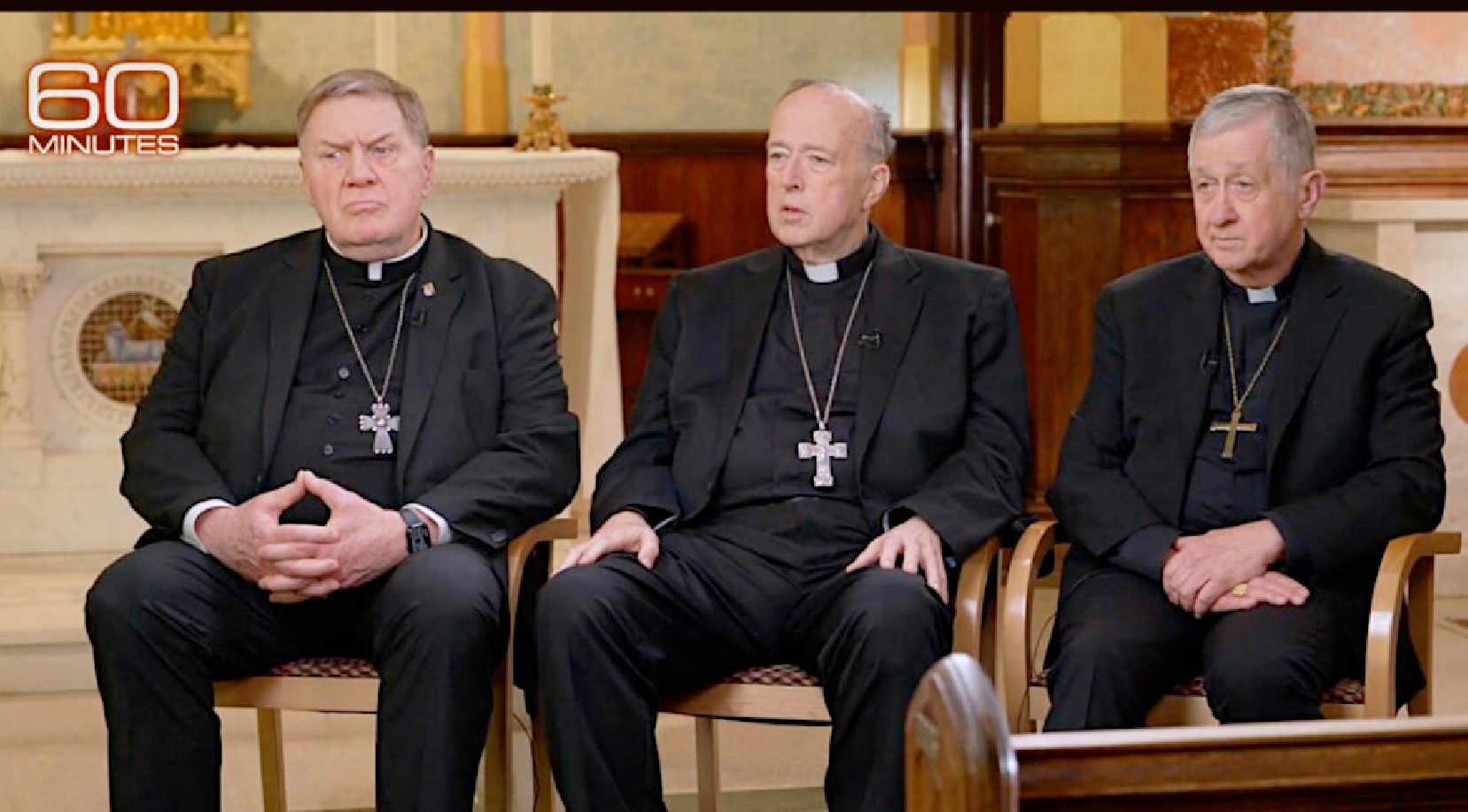
(ZENIT News / Washington, 04.14.2026).- The emergence of a U.S.-born pope has not muted the tensions between faith and power in American public life. On the contrary, it has sharpened them. In a rare and unusually direct intervention, three of the most prominent Catholic leaders in the United States have publicly questioned the moral legitimacy of Washington’s military campaign against Iran, while also confronting broader cultural and political fractures affecting both Church and nation.
Appearing on 60 Minutes, Cardinals Robert McElroy, Blase Cupich and Joseph Tobin offered a coordinated, if nuanced, critique of the current moment. Their intervention came against the backdrop of escalating U.S. military action under Donald Trump and the outspoken calls for peace issued by Pope Leo XIV.
At the center of their argument lies a classical principle of Catholic moral theology: the doctrine of just war. McElroy articulated it with clarity. A war, he insisted, cannot be justified by a multiplicity of shifting aims. Its purpose must be singular and morally coherent: the restoration of justice and peace. In his judgment, the current conflict fails that test. While acknowledging the repressive nature of the Iranian regime, he framed the war as a voluntary choice rather than a last resort, warning that it risks inaugurating a cycle of successive conflicts.
That warning aligns closely with the position of Leo XIV, whose papacy has already been marked by a consistent rejection of military escalation. The Pope’s insistence that violence cannot generate authentic peace has resonated globally, but in the United States it has introduced a particular tension: a Catholic electorate and political class now forced to weigh national strategy against explicit papal teaching.
The friction became unmistakable when Trump publicly criticized the pontiff, accusing him of political interference and urging him to “focus on being a great pope.” The episode underscored a deeper shift. For the first time, an American president confronts not a distant moral authority in Rome, but a compatriot whose voice carries both spiritual and cultural proximity.
Yet the cardinals’ intervention extends beyond geopolitics. Cupich, speaking from Chicago—the Pope’s hometown—denounced what he described as the “gamification” of war in digital media. His critique targeted the transformation of real human suffering into consumable spectacle, where images of bombardment are edited and circulated with the aesthetics of entertainment. Such practices, he argued, erode moral sensitivity and normalize violence in ways that ultimately degrade public conscience.
Tobin, for his part, shifted attention to domestic policy, particularly immigration enforcement. Without condemning individuals, he raised concerns about methods that, in his view, risk undermining constitutional guarantees. His remarks reflected a broader pastoral anxiety: that entire communities are living under a climate of fear. McElroy reinforced this point with empirical detail, noting a 30% drop in attendance at Spanish-language Masses in his archdiocese, a decline he attributed directly to immigration enforcement pressures.
This convergence of foreign policy, media culture and migration reveals a Church grappling with multiple fronts simultaneously. Yet the same interview also pointed to a paradoxical revival within American Catholicism. Dioceses are reporting significant increases in conversions, with Washington alone receiving around 1,800 new Catholics in a single year. For Cupich, the phenomenon remains only partially understood, though he suggested that younger generations are searching for meaning and healing in a fragmented cultural landscape.
McElroy offered a complementary interpretation: a perceived vacuum of moral leadership in public life may be driving some toward religious institutions. Tobin added another layer, suggesting that the figure of Leo XIV himself—his tone, priorities and symbolic weight—has become a catalyst for renewed interest.
The cardinals also revisited the concept of patriotism, seeking to disentangle it from ideological polarization. In their account, patriotism is not blind allegiance but a commitment to a nation’s highest aspirations: justice, equality and the common good. This vision implicitly challenges both nationalist rhetoric and disengaged criticism, proposing instead a form of civic responsibility rooted in ethical coherence.
What emerges from their intervention is not a unified political program but a moral framework. On war, they draw clear limits. On immigration, they call for humane enforcement. On culture, they warn against desensitization. And on faith itself, they identify both crisis and opportunity.
The presence of an American pope has amplified these dynamics rather than resolving them. It has brought the universal claims of Catholic teaching into more immediate dialogue—and sometimes confrontation—with U.S. policy and society. In that sense, the current moment may mark not simply a political dispute, but a deeper test of how religious conviction translates into public life in a polarized age.
Thank you for reading our content. If you would like to receive ZENIT’s daily e-mail news, you can subscribe for free through this link.

Publicaciones relacionadas:
 Cardinal Marc Ouellet and Women’s Congregation Are Convicted in France for “Unjustified Dismissal” of a Nun
 Chinese Communist government takes advantage of Pope’s death to unilaterally impose new bishops
 How many Catholic parliamentarians are there in Germany? This is the religious composition of the German parliament
 A bishop under the age of 60 is the new Patriarch of the Chaldean Catholics
