


(ZENIT News / Rome, 04.15.2026).- As Latin America moves into a dense electoral cycle in 2026—with presidential contests in Peru in April, Colombia in May and Brazil in October, followed by midterm elections in the United States in November—the region’s political landscape is being shaped not only by economic concerns or institutional debates, but also by a persistent and evolving religious factor. Far from retreating into the private sphere, faith continues to influence how millions of voters understand leadership, national identity and even the foundations of law.
Recent survey data collected in 2024 among more than 6,200 adults across six major Latin American countries—Brazil, Mexico, Colombia, Argentina, Peru and Chile—suggest that religion retains a significant, though uneven, public role. In Brazil, Colombia and Peru, roughly two-thirds of respondents consider it important, or very important, that a president defend the religious beliefs of the population. In Argentina, Chile and Mexico, that proportion drops to around half, indicating a more secularized public sensibility but not a fully disengaged one.
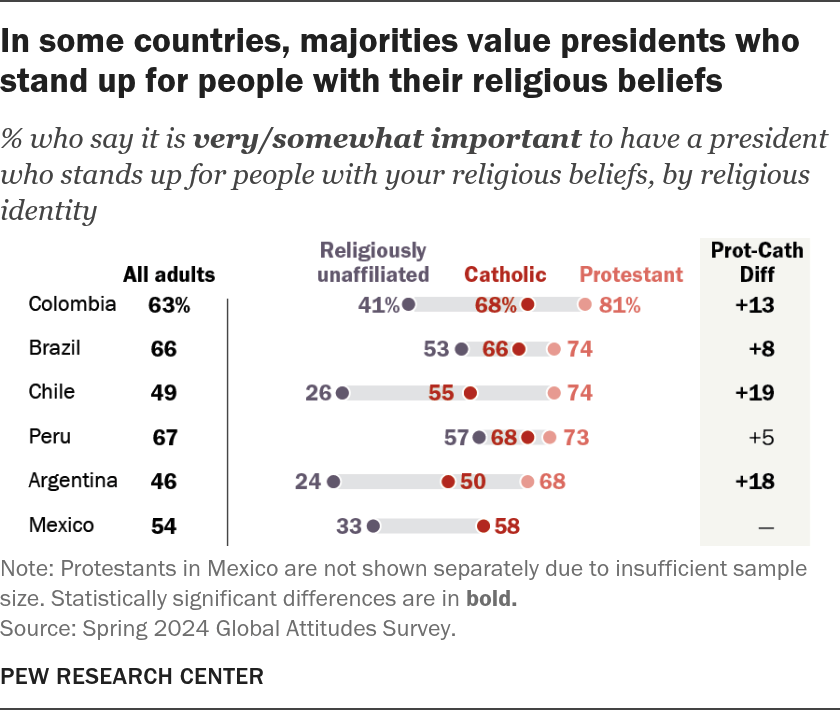
These attitudes are not distributed evenly across religious groups. Protestants, though still a minority in each of the countries surveyed, emerge as the most consistent advocates for a strong religious imprint on public life. Their position is particularly visible when it comes to expectations of political leadership. In Chile, for instance, 74 percent of Protestants say it matters that a president defends their religious beliefs, compared with 55 percent of Catholics and just 26 percent of those with no religious affiliation.
This divergence becomes even more pronounced when the question shifts from general values to personal alignment. In Peru, 59 percent of adults say it is important that a president shares their religious beliefs, while in Chile only 35 percent express the same preference. Across the region, Protestants again lead in prioritizing such alignment, followed by Catholics, with the religiously unaffiliated trailing behind. Yet even among those without formal religious ties, the picture is more complex than often assumed: 53 percent in Brazil and 57 percent in Peru still value a president who defends religious beliefs, suggesting that cultural Christianity continues to shape political expectations beyond institutional affiliation.
The intersection between religion and politics also reveals a clear ideological pattern. Both Catholics and Protestants are more frequently associated with right-leaning positions, and individuals on the political right are consistently more inclined to favor leaders with explicit religious commitments. This alignment does not imply uniformity, but it does point to a shared framework in which moral and social issues are often interpreted through a religious lens.
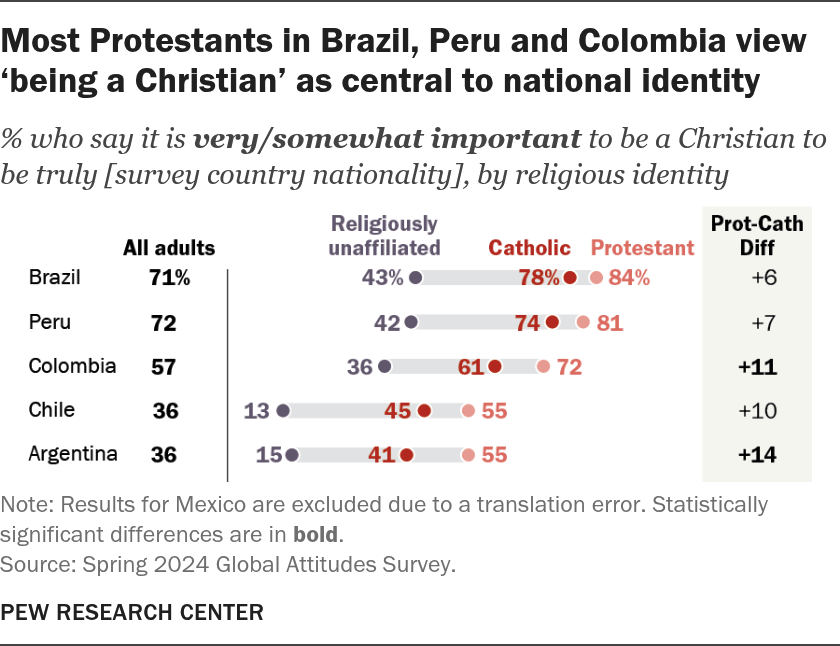
Beyond leadership, religion also informs conceptions of national belonging. In Brazil, Colombia and Peru, majorities of respondents say that being Christian is at least somewhat important to being a “true” member of the nation. In Colombia, the distinction between denominations becomes particularly visible: 72 percent of Protestants link national identity with Christianity, compared to 61 percent of Catholics. By contrast, Argentina and Chile show a weaker connection between religious identity and national belonging, reflecting longer processes of secularization and pluralization.
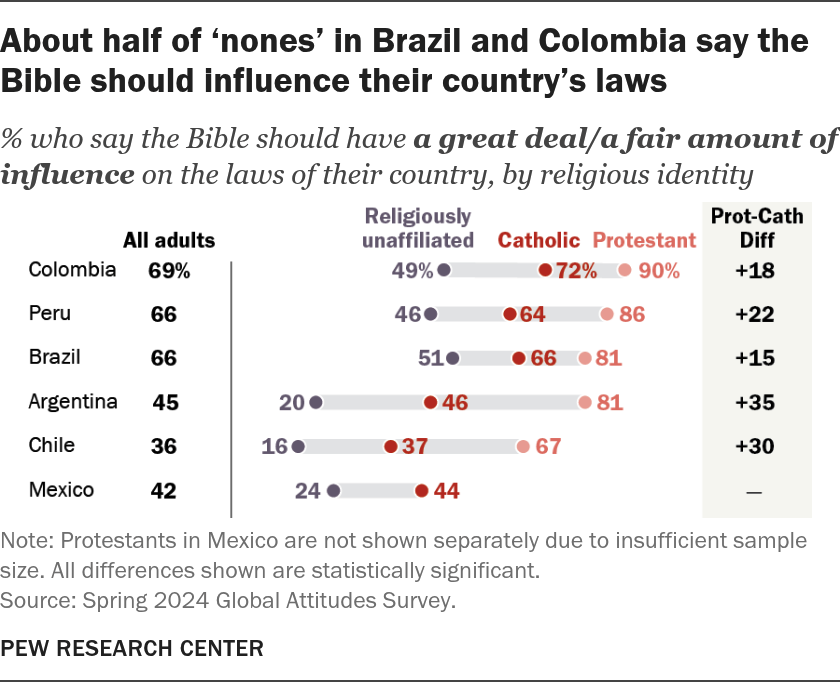
Perhaps the most politically sensitive dimension of this religious influence concerns the legal sphere. In Brazil, Colombia and Peru, about two-thirds of adults believe that the Bible should have a significant influence on national laws. This is not a marginal sentiment but a majority position in some of the region’s largest countries. Protestants again stand out: in Argentina, 81 percent support biblical influence on legislation, compared to 46 percent of Catholics. Even among the unaffiliated, the idea retains traction—51 percent in Brazil and 49 percent in Colombia support such influence, with Peru close behind at 46 percent.
These attitudes coexist with constitutional frameworks that, at least formally, uphold the separation of Church and State. Chile and Peru explicitly affirm this separation, although Peru also acknowledges Catholicism as a historical and cultural pillar. Argentina grants the Catholic Church a form of preferential legal status without declaring an official religion. Colombia guarantees equal freedom for all religious confessions, while Brazil and Mexico constitutionally prohibit state endorsement of any faith.
The resulting landscape is one of tension rather than contradiction. Legal secularism does not necessarily translate into a secular political culture. Instead, many citizens expect religious values to inform public decision-making, even within institutional systems designed to remain neutral.
This dynamic places religious actors in a complex position. Churches, particularly the Catholic Church, continue to exercise moral influence in debates on governance, social justice and national identity. At the same time, the growing visibility of Protestant communities—often more explicit in their political expectations—has introduced new forms of competition and cooperation within the religious field.
As election campaigns intensify across the region, candidates are likely to navigate this terrain carefully. Appeals to religious identity can mobilize significant segments of the electorate, but they also risk deepening polarization in societies already marked by ideological divides.
What emerges from the data is not a simple return of religion to politics, but a transformation of its role. Faith is no longer a monolithic force aligned with a single institution; it is a plural and sometimes fragmented influence that intersects with ideology, culture and national narratives. In a year when millions of Latin Americans will cast their votes, that influence is set to remain a decisive, if often understated, factor in shaping the region’s political future.
Thank you for reading our content. If you would like to receive ZENIT’s daily e-mail news, you can subscribe for free through this link.

Publicaciones relacionadas:
 Pope Francis continues to pursue dialogue with China but will Beijing do the same?
 Macron in the square, the archbishop in the cathedral, the Pope in the Vatican: this is what the reopening of Notre Dame will be like
 The British and their attunement to Christian religious heritage
 Why the people Stay, Leave, or Return to Religion in a Changing Spiritual Landscape
