

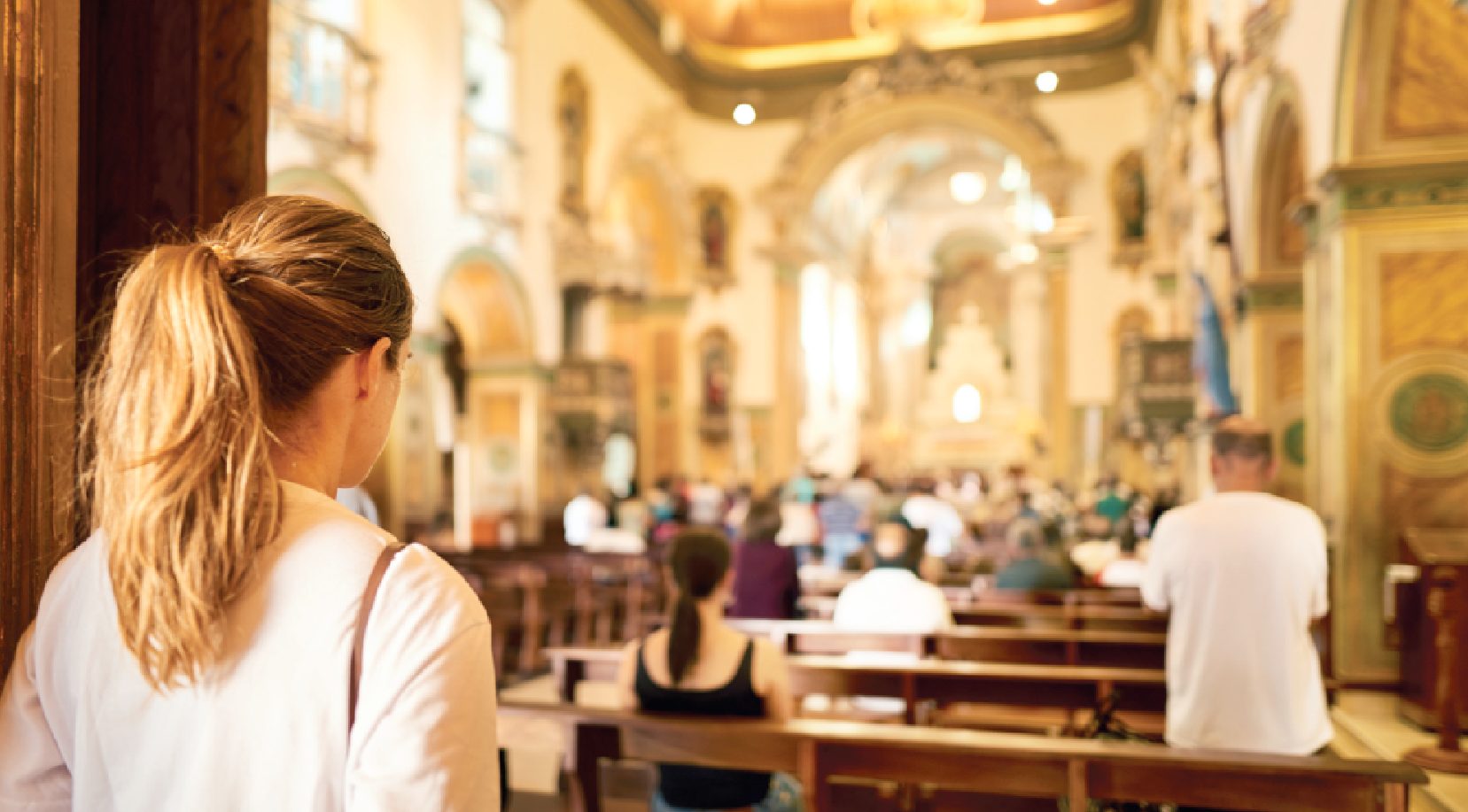
(ZENIT News / Bogotá, 04.29.2026).- At a time when Western societies are grappling with rising levels of anxiety, loneliness, and chronic illness, an unexpected voice has entered the conversation: that of a physician pointing not to a new drug or therapy, but to a centuries-old practice. The proposal is simple, even countercultural in its implications—regular participation in the Eucharist may be associated with measurable improvements in physical and mental health.
The reflection, shared publicly by internist José Jorge Maya, draws on a growing body of research exploring the intersection between religious practice and well-being. While careful to avoid overstating the conclusions, the physician highlights a series of statistical associations that have attracted increasing attention in medical and public health circles.
Among individuals who attend religious services at least once a week, the data suggest a pattern that is difficult to ignore. On average, these individuals show a 21 percent lower risk of cancer, a 29 percent reduction in smoking, and a 34 percent decrease in excessive alcohol consumption. Equally significant in today’s mental health landscape is a reported 33 percent lower risk of depression.
Perhaps the most striking figure concerns mortality. Regular attendance is associated with a 27 percent reduction in the risk of death from any cause. Such a claim, if taken in isolation, might invite skepticism. Yet the physician insists that these outcomes should not be interpreted as extraordinary or inexplicable, but rather as the cumulative effect of well-known behavioral and psychosocial factors.
From a clinical standpoint, the logic is coherent. Lower rates of smoking and alcohol abuse translate into reduced incidence of cancer and cardiovascular disease. Improved mental health reduces vulnerability to a range of chronic conditions. In this sense, what appears at first glance as a religious variable can be understood, at least partially, through established medical pathways.
The implications extend beyond adults. Among adolescents, regular participation in religious life correlates with lower engagement in high-risk sexual behavior and reduced substance abuse. These findings are particularly relevant in a cultural environment where early exposure to such risks is often linked to long-term health and social consequences.
To explain these patterns, the physician identifies three underlying dynamics that resonate with both medical research and classical Christian anthropology. The first is the role of community. Regular worship places individuals within a stable network of relationships, mitigating one of the most pervasive public health challenges of the modern age: social isolation. Loneliness, now widely recognized as a risk factor comparable to smoking or obesity, finds a natural antidote in shared religious life.
The second factor is psychological. Participation in liturgical life is associated with reduced stress and an increased sense of inner peace. In a society marked by constant stimulation and uncertainty, structured moments of silence, reflection, and transcendence may function as a form of emotional regulation that modern medicine is only beginning to quantify.
The third element is perhaps the most elusive, yet arguably the most decisive: the presence of meaning. To live with a sense of purpose has long been associated with better health outcomes, but it remains difficult to measure. Religious belief, particularly in its sacramental expression, offers a coherent narrative of human existence that situates suffering, responsibility, and hope within a broader horizon.
It is important, however, to situate these findings within their proper methodological limits. Much of the available evidence comes from observational studies, which can identify correlations but do not establish direct causation. Individuals who attend religious services regularly may already differ in significant ways—socially, culturally, or behaviorally—from those who do not.
Yet even with these caveats, the consistency of the data across different studies has led some researchers to argue that religious participation should not be dismissed as a marginal or purely private matter. Instead, it may represent a relevant, if often overlooked, component of what public health experts describe as “integral well-being.”
In the Catholic Church, the idea that the human person is a unity of body and soul is foundational. The suggestion that sacramental life might bear fruit not only in spiritual terms but also in tangible aspects of daily existence does not come as a surprise within that framework. What is new is the language in which this intuition is now being revisited: that of epidemiology, behavioral science, and preventive medicine.
Dr. Maya’s personal testimony adds a dimension that statistics alone cannot capture. His observation—that those who attend church do not leave in a worse state than when they entered, but rather with greater calm and clarity—points to an experiential reality that precedes and, in some ways, transcends quantification.
In the end, his recommendation is disarmingly straightforward: those who have the opportunity to attend Mass weekly should consider doing so. Not as a substitute for medical care, nor as a guaranteed solution to complex health problems, but as part of a broader way of life that integrates relationships, discipline, and meaning.
The convergence of medical observation and religious practice raises a question that is both ancient and newly relevant: whether some of the most effective remedies for human fragility have been present all along, quietly embedded in the rhythms of communal and spiritual life.
Thank you for reading our content. If you would like to receive ZENIT’s daily e-mail news, you can subscribe for free through this link.

Publicaciones relacionadas:
 Cardinal Christoph Shönborn: I Am Impressed by the Pope’s Patience with the German Bishops
 Argentina: Carmelite Nun of the Beautiful Smile Who Died of Cancer, Begins Her Path to the Altars
 Official: 72nd miracle of Our Lady of Lourdes recognized: healing of woman with lateral sclerosis
 Corporate support for “gay pride” falls. Campaign launched by people who left LGBT+ activism
