

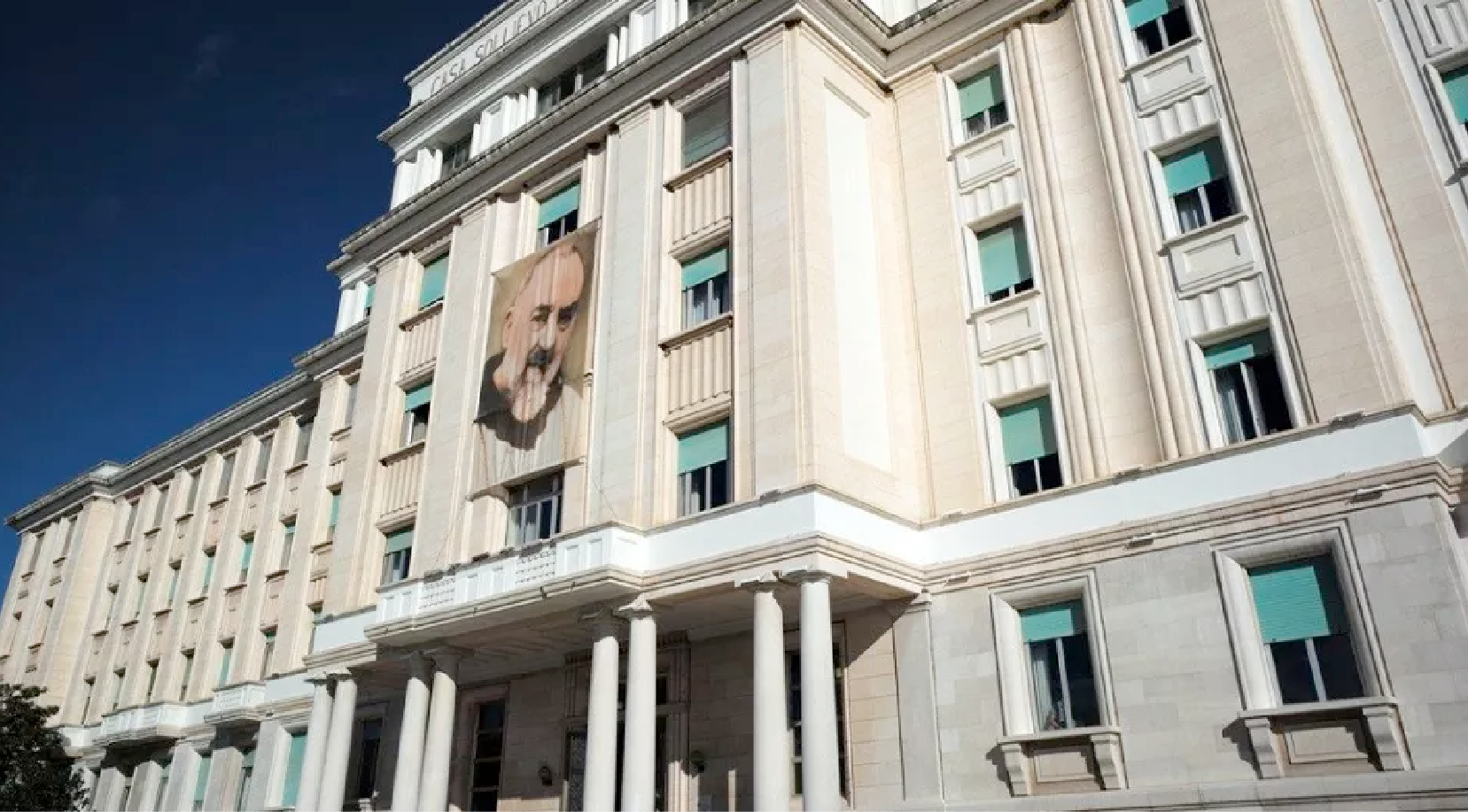
(ZENIT News / Rome, 05.28.2026).- When Saint Pio of Pietrelcina dreamed of building a hospital in southern Italy after the devastation of World War II, many considered the idea unrealistic. The Capuchin friar known worldwide as Padre Pio envisioned not merely a medical center, but what he called a “House for the Relief of Suffering” — a place where physical care and spiritual compassion would coexist.
More than seven decades later, that vision remains alive, but the institution itself now faces one of the gravest crises in its history.
On May 27, Pope Leo XIV signed a papal chirograph establishing a special commission with extraordinary powers to stabilize and relaunch Casa Sollievo della Sofferenza, the renowned Catholic hospital in San Giovanni Rotondo founded by Padre Pio in the 1950s. The decision marks one of the most significant governance interventions of Leo XIV’s young pontificate and reveals how seriously the Vatican views the deteriorating financial condition of one of Italy’s most symbolic Catholic healthcare institutions.
The hospital, which has long enjoyed an excellent medical reputation and attracts patients from across southern Italy, is burdened by debts estimated between €220 million and €300 million. The crisis has expanded beyond accounting problems into labor disputes, tensions with trade unions, delayed salaries in some cases, and a bitter disagreement with the regional government of Apulia over reimbursements amounting to roughly €32 million.
Cardinal Pietro Parolin, the Vatican Secretary of State, acknowledged the seriousness of the situation earlier this month during a visit to the hospital, while insisting that “we will emerge from this together.”
The new Vatican commission has been entrusted with precisely that mission.
According to the papal decree, the body will analyze the institution’s current condition, identify strategies to improve efficiency and long-term sustainability, and directly implement reforms. Significantly, the commission has authority not only over ordinary administration but also extraordinary governance measures. In practical terms, it can even act in place of the hospital foundation’s statutory governing organs when necessary.
That level of intervention is unusual and underlines the urgency perceived inside the Vatican.
The commission will be chaired by Maximino Caballero Ledo, prefect of the Secretariat for the Economy, while Fabio Gasperini — secretary general of the Governorate and a key Vatican financial administrator — will coordinate operations. Other members include Archbishop Giordano Piccinotti, president of the Administration of the Patrimony of the Apostolic See; Archbishop Paolo Rudelli from the Secretariat of State; and Archbishop Giorgio Ferretti of Foggia-Bovino. A technical committee composed of financial, legal, and administrative experts will assist the process.
Pope Leo’s decree repeatedly emphasizes a theme that has become central to modern Catholic institutions: fidelity to mission requires competent stewardship. The document notes that changing economic, technological, and legal realities compel the Church to pursue “continuous renewal,” especially in healthcare, where investment and prudent management are indispensable.
This is not simply financial language. Catholic hospitals occupy a unique place in the Church’s social mission. Historically, many were founded not as profitable enterprises but as works of mercy intended to serve the poor, the sick, and pilgrims who might otherwise lack care. Casa Sollievo embodied that ideal perhaps more dramatically than most. Padre Pio personally raised support for the project and insisted that care for the suffering body was inseparable from care for the soul.
That spiritual identity explains why the Vatican is unwilling to allow the institution to drift toward collapse.
The intervention also fits into a broader pattern emerging under Leo XIV. Since his election, the Pope has already issued multiple decrees restructuring or correcting the administration of Vatican-linked entities. He dissolved the organization responsible for the World Children’s Day initiative, curtailed the financial autonomy of St. Peter’s Basilica, and reorganized central structures of the Diocese of Rome. The message is increasingly clear: charitable and ecclesial institutions must combine evangelical mission with transparency, accountability, and sustainable governance.
At the same time, the crisis surrounding Casa Sollievo highlights a wider challenge facing Catholic healthcare across Europe. Rising operational costs, demographic decline, labor shortages, and increasingly complex public-health systems are putting enormous pressure on religious institutions that were built in a different era. Many Catholic hospitals today struggle to preserve both financial viability and religious identity.
For the Vatican, however, the stakes in San Giovanni Rotondo are especially symbolic. Padre Pio remains one of the most beloved saints of modern Catholicism, and his hospital is inseparable from his legacy. Millions of pilgrims continue to visit the town every year, not only to pray at the saint’s shrine but also because the institution itself represents a concrete expression of Christian charity.
The Pope’s intervention, therefore, is not merely an administrative act. It is an attempt to preserve a spiritual inheritance born from the conviction that suffering should never be faced alone.
Thank you for reading our content. If you would like to receive ZENIT’s daily e-mail news, you can subscribe for free through this link.

Publicaciones relacionadas:
 Pope Leo’s visit to Argentina unofficially confirmed after audience with President Milei
 This is the first YouTube video message from Pope Leo XIV to USA
 Pope confirms new Custos of the Catholic Church for the Holy Places in the Holy Land
 The Pope is met with an attack in Algeria; in Cameroon, he is greeted by an announcement of a ceasefire amid the civil war
