

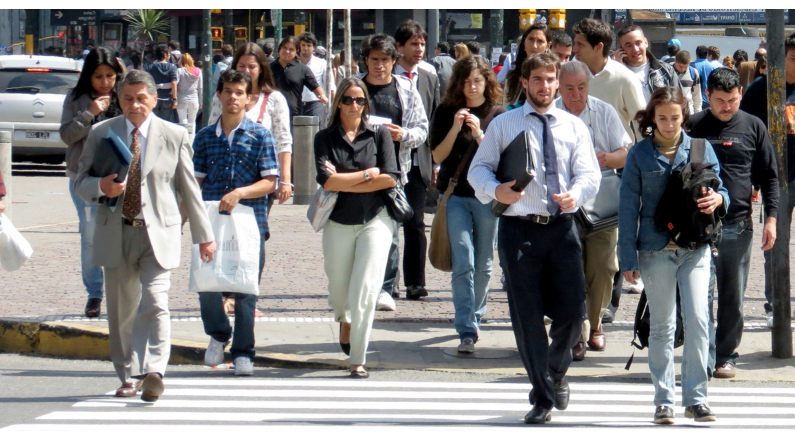
(ZENIT News / Buenos Aires, 06.23.2026).- If Pope Leo XIV visits Argentina later this year, as many expect, he will encounter a religious landscape profoundly different from the one that greeted St. John Paul II during his historic visits in 1982 and 1987. The country remains overwhelmingly spiritual, but the institutional map of faith has been redrawn by decades of religious change.
A new nationwide survey from the University of Buenos Aires’ Barometer of Religions and Beliefs confirms a long-term trend that has reshaped much of Latin America: the steady decline of Catholic affiliation, the sustained growth of evangelical Christianity, and the rise of a growing sector that identifies with no religion while often maintaining personal spiritual beliefs.
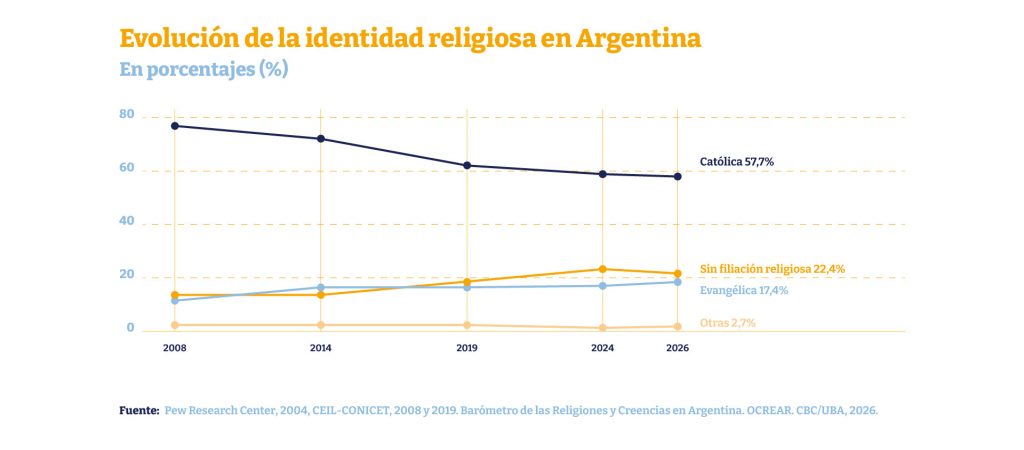
The numbers tell a striking story. In 1960, Catholics represented approximately 90 percent of Argentina’s population. Today, according to the latest survey, they account for 57.7 percent. Previous studies by the National Scientific and Technical Research Council had already documented the decline, recording Catholic affiliation at 76.5 percent in 2008 and 62.9 percent in 2019.
At the same time, evangelical churches continue their expansion. Evangelicals now represent 17.7 percent of Argentines, nearly doubling their share since 2008, when they accounted for 9 percent of the population. By 2019, they had already reached 15.3 percent.
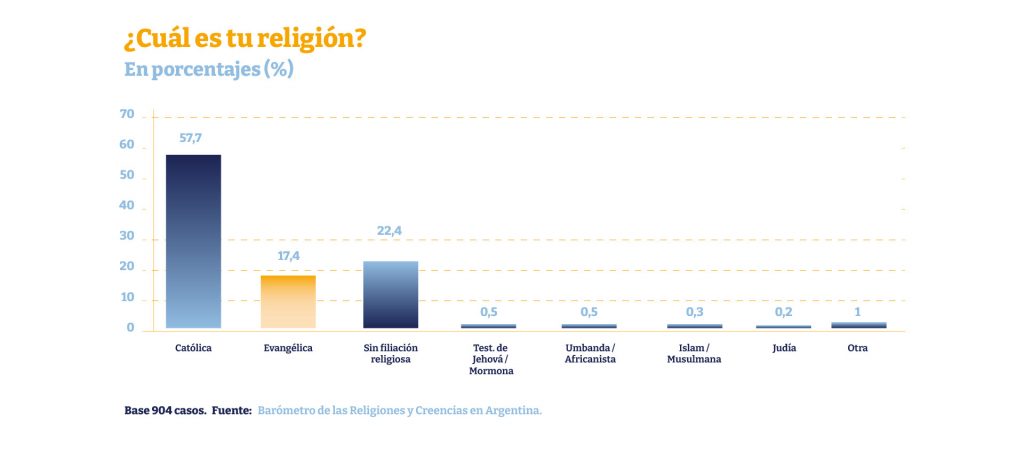
Perhaps the most significant development, however, is the emergence of the religiously unaffiliated as the country’s second-largest category. According to the survey, 22.4 percent of Argentines now identify with no religion, surpassing evangelicals and trailing only Catholics. Yet this group is far from homogeneous. It includes people who retain some openness to transcendence, agnostics who consider both belief and unbelief plausible, and atheists. Many continue to practice forms of spirituality despite rejecting formal religious affiliation.
This distinction is crucial. The survey found that nearly 90 percent of Argentines still believe in God. In other words, the decline of institutional religion is not necessarily producing a secular or atheist society. Instead, many people appear to be distancing themselves from religious organizations while preserving personal beliefs and spiritual practices.
The generational divide is particularly revealing. Among Argentines aged 16 to 29, only 44.6 percent identify as Catholic, compared with 69 percent among those over 50. Evangelical communities perform significantly better among younger adults, reaching 23.6 percent in that age group. Meanwhile, nearly one-third of young people—31 percent—claim no religious affiliation at all.
For sociologists, this trend reflects a broader phenomenon extending well beyond Argentina. Juan Esquivel, director of the Barometer, argues that the growth of the religiously unaffiliated is occurring across much of the Western world. In several European countries, including the Czech Republic, Estonia, Latvia, the Netherlands, and even the United Kingdom, people without religious affiliation have become one of the most significant demographic groups.
What is happening, therefore, is not simply a Catholic problem but part of a wider cultural transformation. Traditional institutions that once provided identity, belonging, and meaning—including political parties, labor unions, schools, and religious organizations—have seen their influence weaken. The religious sphere has not escaped this process.
The trend is visible throughout Argentina, although not everywhere with the same intensity. Religious practice remains stronger in some northern regions, while the Buenos Aires metropolitan area exhibits the sharpest declines in Catholic affiliation and the fastest growth among evangelicals and the unaffiliated.
The survey also highlights important social differences. Evangelical churches tend to attract greater support among sectors with lower educational attainment, often through strong networks of community assistance, social support, and local engagement. By contrast, higher educational levels are more frequently associated with non-affiliation and greater cultural individualism.
Yet the relationship between education and faith remains contested. Pope Francis himself challenged the assumption that education necessarily weakens religious belief. Reflecting on the issue, he argued that material prosperity may pose a greater challenge to faith than academic formation. Economic self-sufficiency, he suggested, can create the illusion that God is no longer necessary, while excessive attachment to wealth risks becoming a form of idolatry.
The late Argentine Pope repeatedly insisted that the Church’s response to declining affiliation could not be reduced to marketing strategies or institutional reforms. Echoing a famous insight of Pope Benedict XVI, Francis maintained that Christianity grows through attraction rather than proselytism. The decisive factor, he argued, is credible witness.
That perspective may prove especially relevant today. The survey suggests that while religious identities are changing, the human search for transcendence remains remarkably resilient. Argentina may have fewer Catholics than in previous generations, but it is still a nation where belief in God is widespread and where spiritual questions continue to shape public life.
Thank you for reading our content. If you would like to receive ZENIT’s daily e-mail news, you can subscribe for free through this link.

Publicaciones relacionadas:
 Poland: Experts express serious concerns about Overbeek’s book about John Paul II
 USA: Catholics At The Top of Religions That Inspire Positive Sentiments Among the People in General
 What is the religion of the people who migrate the most? Research answers and Mexico is part of the answer
 The health (physical, mental, and spiritual) of Australian clergy in 2025: What interesting research reveals
