

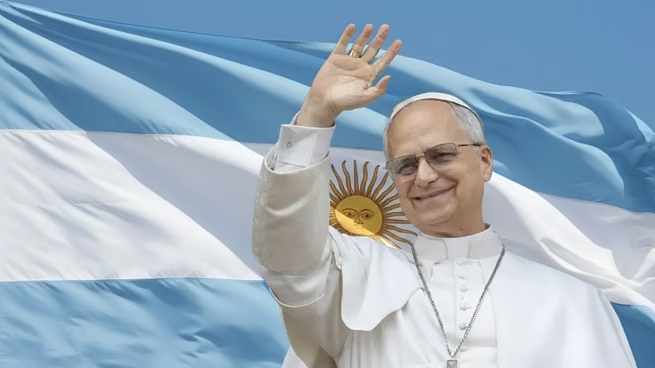
(ZENIT News / Buenos Aires, 10.07.2026).- When Pope Leo XIV arrives in Argentina on November 8, he will encounter a country preparing an extraordinary welcome, but also one that its own Catholic leaders describe in deeply troubled terms. Over four days, the Pope will travel through Buenos Aires, Córdoba and Luján, where millions could gather to see him. Behind the ceremonies, however, lies a more difficult reality: poverty, political polarization and social divisions that Archbishop Jorge García Cuerva says have left Argentina “wounded.”
The preparations for the November 8–11 apostolic visit are now moving into a more practical phase. The Argentine bishops’ conference has launched the official website for the trip, providing information about the scheduled celebrations, meetings and participation requirements. From October 8, pilgrims and volunteers will be able to register, while journalists and media organizations will receive information about accreditation.
The registration system is designed to accommodate different forms of participation, from individual and group pilgrims to people with disabilities, consecrated men and women, deacons, seminarians and priests wishing to concelebrate. Among the events requiring registration are the Mass and meeting with young people at the Monument to the Spaniards, the Mass in Córdoba, the meeting with seminarians, priests and members of consecrated life at Córdoba Cathedral, and the Mass at the Basilica of Luján.
Registration, however, will not itself guarantee a particular place within a celebration. The organizers are preparing for crowds on a scale that could test even a carefully coordinated operation.
The clearest indication of what is coming can already be seen at Luján. More than one million pilgrims are expected for this year’s 52nd Youth Pilgrimage to the national shrine, with more than 20,000 volunteers involved in the organization and national, provincial and local authorities working alongside the Church. The pilgrimage covers roughly 60 kilometers from the Sanctuary of Saint Cajetan in Liniers to the Basilica of Our Lady of Luján.
That event has also served as something of a rehearsal for the Pope’s arrival. Leo XIV is scheduled to celebrate Mass at Luján on November 11, the final day of his visit, and local authorities estimate that between one and two million people could attend. Plans reportedly include a two-kilometer concentration area and staggered arrivals to manage the enormous crowd.
But Argentina is preparing more than barriers, registration forms and transportation plans. It is preparing a national welcome with music and art, attempts to give the visit a distinctly Argentine character, and an effort to ensure that the Pope’s arrival is experienced not simply as a series of official events but as a moment of popular participation.
The bishops’ conference has selected “Argentina with Pope Leo” as the official song for the visit after receiving compositions from communities throughout the country. Children, young people, adults and parish communities submitted songs anonymously, reflecting different regional styles and accents. The winning composition was written by Gabriel Alejandro Moyano Angelini and Agustín Moyano Angelini.
The choice is more than a ceremonial detail. The bishops have encouraged parishes and other pastoral communities to continue sharing the songs that were submitted, arguing that the creative effort generated by the visit should not disappear once the official celebrations begin. In that sense, the preparations are already attempting to turn the papal journey into a collective religious experience rather than a spectacle centered exclusively on the Pope.
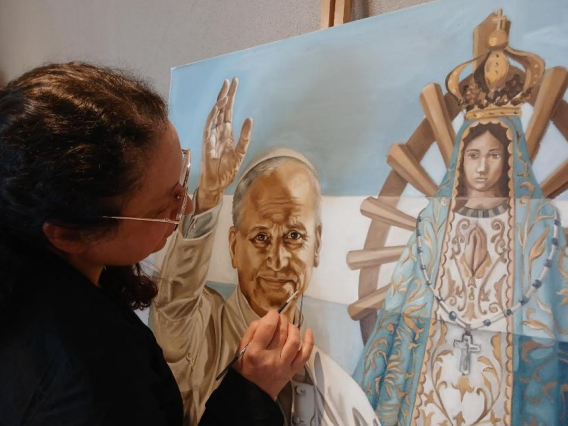
Art is playing a similar role. Argentine painter Mercedes Fariña has produced two previously unpublished oil paintings of Leo XIV, each measuring 70 by 70 centimeters. One places the Pope alongside his predecessor, Francis; the other depicts him with Our Lady of Luján, whose shrine will be one of the central destinations of his journey.
Fariña has a longstanding connection with the Vatican. One of her works entered the Vatican Collection in 2013, followed by a second painting in 2014 that was displayed in the offices of the Pontifical Council for Culture. She had already painted Leo XIV in 2025, only four days after his election in the conclave.
Her new painting “The Legacy” places Leo in a contemplative pose while Francis appears behind and above him, suggesting continuity between the two pontificates. The work also incorporates part of a handwritten letter Fariña received from Francis, giving the image a personal dimension rather than presenting it simply as a formal portrait.
The second painting, “Welcome All,” shows Leo smiling and blessing the viewer, with the image of Our Lady of Luján appearing behind him and the colors of the Argentine flag incorporated into the background. Fariña has described the works as part of a realist, Renaissance-inspired approach and connected them to the human-centered concerns of Leo’s teaching while also defending traditional painting at a time when digital aesthetics are increasingly dominant.
Yet perhaps the most important portrait of Argentina’s encounter with Leo XIV has been painted not on canvas but in words by García Cuerva.
The archbishop of Buenos Aires has warned that the Pope will find “a wounded Argentina,” marked by poverty, intolerance and political division. He has spoken of a country where polarization affects everyday life, where public debate is frequently characterized by disqualification and intolerance, and where many people have endured poverty for years.
His diagnosis was unusually candid. Argentina, he said, has been in crisis for many years, recalling his grandfather’s confidence that the country would eventually recover. “I have already grown up,” García Cuerva said in essence, “and Argentina remains in that situation.”
But the archbishop did not describe a nation without hope. His other Argentina is composed of workers who get up every day, families that continue to struggle, and people who refuse to surrender despite repeated disappointments.
That contrast may ultimately define Leo XIV’s visit more than any individual ceremony. The Pope will arrive amid a country that has plenty of reasons for frustration but also possesses a remarkably visible capacity for religious expression and communal solidarity.
The symbolism of Luján is particularly powerful in that regard. Millions are expected to converge on a Marian shrine, many after walking long distances, at a time when the country remains deeply divided. This year’s pilgrimage carries the theme “Mother, in your embrace we recognize ourselves as brothers,” an unusually fitting message for a society that continues to wrestle with its divisions.
García Cuerva has described Leo’s journey as pastoral rather than merely political and has warned that it should leave the Argentine Church with “homework.” That may be the most consequential expectation surrounding the visit.
Thank you for reading our content. If you would like to receive ZENIT’s daily e-mail news, you can subscribe for free through this link.

Publicaciones relacionadas:
 Pope Leo XIV will visit Uruguay, according to statements from the Uruguayan government: here’s what we know
 Before the Pope’s arrival: a survey reveals the popularity of Pope Leo XIV, as well as the expectations and topics of interest among those who will welcome him in Spain
 Keiko Fujimori Visits the Peruvian Episcopate and Gets Involved in the Upcoming Visit of Pope Leo XIV to Peru
 Leo XIV encourages religious to view community life as a source of inspiration and sanctification
