

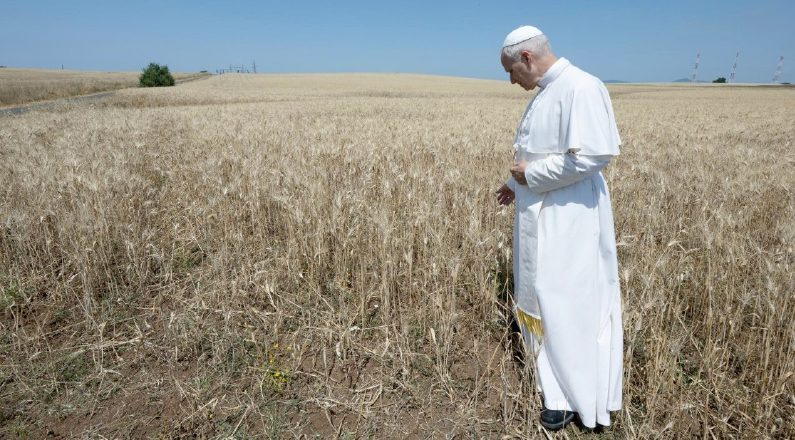
(ZENIT News / Roma, 06.03.2026).- Pope Leo XIV has taken a significant step in transforming one of Pope Francis’ most far-reaching environmental initiatives into a concrete institutional reality. Through a pontifical decree dated June 1, 2026, he has established the “Fratello Sole” Foundation, a new Vatican entity tasked with overseeing a large agrivoltaic project designed to provide the entire Vatican City State with sustainable energy.
The initiative marks a new phase in the Holy See’s long-term effort to combine environmental responsibility, technological innovation, and practical stewardship of resources. More than a symbolic ecological gesture, the project seeks to make the Vatican fully self-sufficient in energy production while preserving agricultural activity and protecting the surrounding landscape.
The foundation will be headquartered within Vatican City but will operate primarily in the extraterritorial area of Santa Maria di Galeria, northwest of Rome. This site is well known in Vatican history: since 1957 it has housed the transmission facilities of Vatican Radio, one of the Church’s most important communication instruments throughout the twentieth century.
Under the new plan, the area will host an agrivoltaic installation capable of generating renewable electricity while allowing agricultural use of the land beneath and around the solar infrastructure. The objective is twofold: to guarantee the energy needs of the Vatican Radio complex and, ultimately, to supply the entire Vatican City State.
The project did not emerge overnight. Its roots lie in Pope Francis’ environmental vision, particularly his 2015 encyclical Laudato Si’, which called for greater responsibility in caring for creation and encouraged the development of cleaner forms of energy. Francis later returned to the subject in Laudate Deum and, in June 2024, issued the motu proprio Fratello Sole, formally launching the process that would eventually lead to the construction of the plant.
A decisive milestone came on July 31, 2025, when the Holy See and the Italian Republic signed a bilateral agreement regulating the development of the facility. That agreement officially entered into force on May 27, 2026, clearing the way for the creation of the new foundation and the implementation of the project.
In establishing the foundation, Leo XIV described it as “a sign of hope for the future” and a demonstration that energy production and agriculture need not be viewed as competing interests. Instead, the project aims to show that technological progress, food production, and environmental protection can be integrated within a single sustainable model.
The technical ambitions are substantial. According to previous Vatican explanations, the installation will employ solutions intended to preserve agricultural activity, safeguard the hydrogeological balance of the area, minimize environmental impact, and protect the cultural, archaeological, and landscape heritage of the site. In other words, success will be measured not only by megawatts generated but also by the project’s ability to respect the territory in which it operates.
Leo XIV has already personally visited the Santa Maria di Galeria complex. During a visit in June 2025, he described the initiative as a valuable opportunity for the Church to offer a concrete example to the wider world. Referring to the growing concerns surrounding climate change, he emphasized the responsibility of caring for creation, echoing themes that have become a permanent part of contemporary Catholic social teaching.
The newly established foundation has also been given a broader mandate than managing a single energy facility. Its statutes allow it to promote additional agrivoltaic projects in other locations, collaborate with scientific institutions on renewable-energy research, and participate in international organizations dedicated to sustainable energy development.
For its initial three-year term, Leo XIV has entrusted leadership of the foundation to two senior Vatican administrators: Sister Raffaella Petrini, President of the Governorate of Vatican City State, who will serve as president, and Archbishop Giordano Piccinotti, President of the Administration of the Patrimony of the Apostolic See, who will serve as vice president.
The creation of the Fratello Sole Foundation illustrates an important continuity between the pontificates of Francis and Leo XIV. While the two Popes have distinct personal styles, this project demonstrates how major initiatives can transcend individual pontificates and become part of a longer institutional vision.
Thank you for reading our content. If you would like to receive ZENIT’s daily e-mail news, you can subscribe for free through this link.

Publicaciones relacionadas:
 Vatican convenes 300 pastors from around the world in preparation for synod on synodality 2024
 Anglican «bishop» woman who spoke before the Pope: I was invited «to describe the Anglican way for women’s ordination.»
 Vatican Museums offer Marian tour of Pope’s gardens in May
 Letters to the Pope: A Hundred Kilograms of Hope and Humanity Delivered Daily to the Vatican
