

(ZENIT News / Cologne, 06.15.2026).- A statue said to shed tears of blood in southern Italy and renewed scrutiny of alleged Marian apparitions in Germany have once again brought an enduring question to the forefront of Catholic life: how should the Church respond when the extraordinary appears to break into ordinary reality?
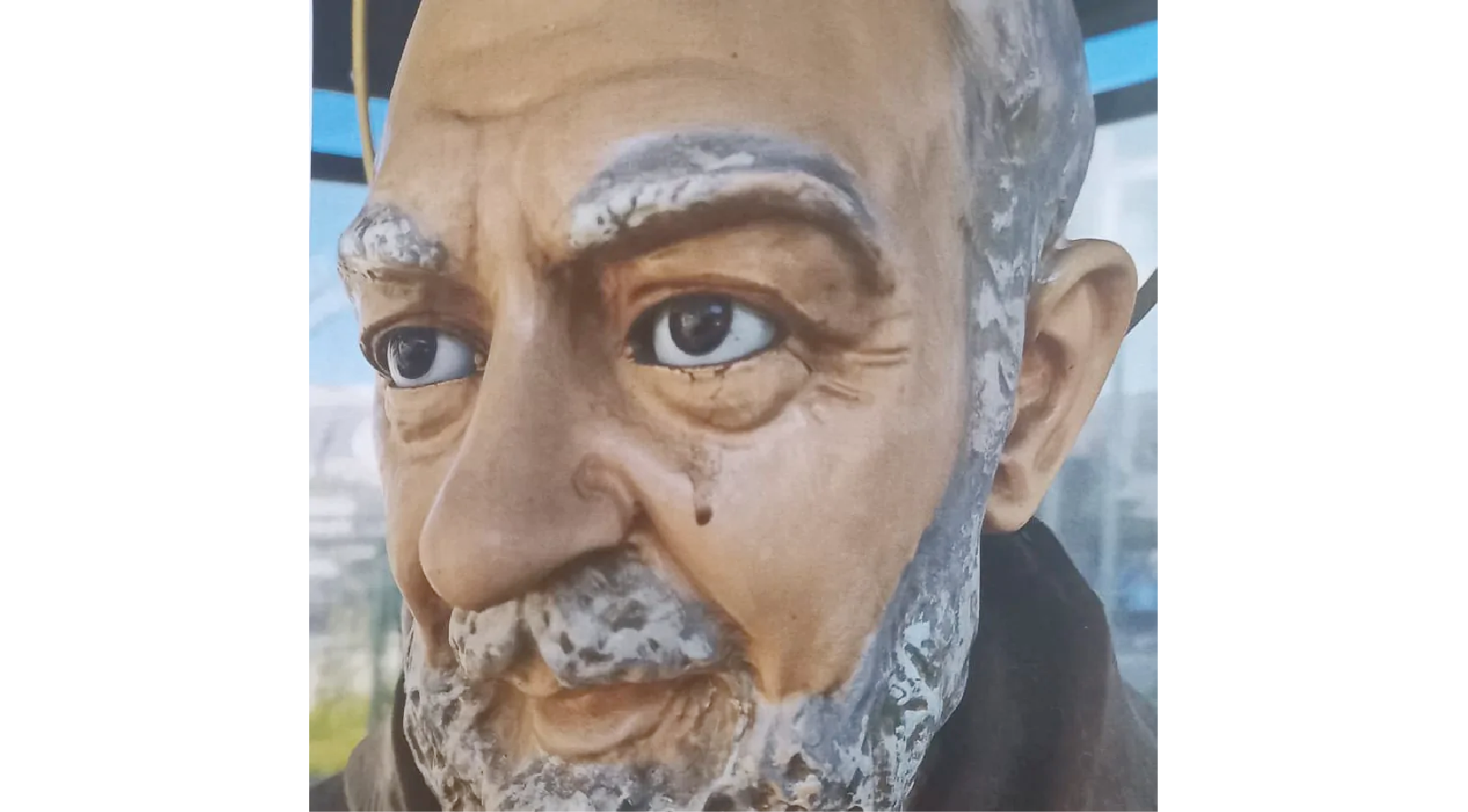
In recent weeks, the small parish of Madonna delle Grazie in Casalba, near Naples, has become an unexpected destination for pilgrims, journalists and the simply curious. The reason is a fiberglass statue of Saint Padre Pio that reportedly began displaying a reddish tear-like drop beneath one eye.
The phenomenon was first noticed on April 18. Parish priest Father Girolamo Capuano initially assumed it was dirt or some accidental stain. Yet repeated attempts to remove it proved unsuccessful. After reviewing security footage covering the entire month, he concluded that no one had physically altered the statue. The local diocese is now investigating whether the substance is in fact blood.
For Father Capuano, the episode has already produced one undeniable effect: it has rekindled prayer and attracted people who might otherwise never enter a church. Even so, he readily acknowledges that ecclesiastical recognition is far from certain.
His caution reflects a lesson learned not only by the Church but by his own community. The same town experienced excitement in 2015 when reports spread that a statue of the Virgin Mary was weeping. Subsequent investigation determined that rainwater infiltration was responsible.
That distinction between spiritual enthusiasm and factual verification lies at the heart of the Catholic approach to alleged supernatural phenomena.
The Church’s modern procedures have become even more rigorous since the Vatican’s 2024 norms governing the discernment of purported supernatural events. Under the new framework, the primary goal is no longer to declare with certainty that a phenomenon comes directly from heaven. Instead, Church authorities assess its pastoral fruits, theological soundness and possible risks to the faithful.
The process allows for several outcomes, ranging from a favorable judgment that permits devotion to continue to a determination that a phenomenon should be discouraged or even prohibited. In every case, the local bishop conducts the initial investigation before submitting conclusions to the Dicastery for the Doctrine of the Faith in Rome.
The practical result is that dramatic claims now face a long path of scrutiny before receiving any ecclesiastical endorsement.
That same framework is currently being applied hundreds of miles north of Italy.
In Germany, the Diocese of Aachen has formally established a commission to investigate reports of Marian apparitions in the village of Sievernich, a community of only about 500 inhabitants west of Cologne. The commission is chaired by canon lawyer and Church-State relations expert Stefan Mückl and includes four specialists tasked with examining events that have attracted attention for more than two decades.
The reported apparitions date back to the early 2000s, when a local woman claimed that the Virgin Mary appeared to her in the parish church of Saint John the Baptist, dressed in white and covered by a long veil. According to her testimony, the messages emphasized themes familiar throughout Marian spirituality: prayer, conversion and care for those in need.
Interest spread rapidly. Pilgrims began arriving from across Germany and beyond. At one gathering in October 2002, hundreds reportedly attended an event that had been announced as the final scheduled apparition. The visionary later maintained that occasional encounters continued until 2005.
What makes both the Italian and German cases noteworthy is not simply the extraordinary nature of the claims but the Church’s determination to investigate them carefully rather than either embrace or dismiss them prematurely.
This prudence is rooted in centuries of experience. Contrary to popular perception, Catholics are not required to believe in private revelations, even when they receive Church approval. The faith itself rests on divine revelation contained in Scripture and Tradition. Apparitions, visions and miraculous signs may encourage believers, but they add nothing essential to the deposit of faith.
Yet history also shows why such events continue to attract attention. Some of the most influential places of Catholic pilgrimage—from Lourdes to Fatima—began as reports that many initially regarded with skepticism.
The current investigations therefore unfold in a space between faith and caution, hope and verification. Whether the tear on the face of Padre Pio or the reported visions at Sievernich ultimately receive a positive judgment remains uncertain.
What is already clear, however, is that these events continue to touch a deep spiritual instinct. In an age often marked by secularization and uncertainty, many believers remain attentive to signs that might point beyond the visible world. The Church, for its part, seeks to ensure that such hopes are guided not by sensationalism, but by truth, discernment and authentic faith.
Thank you for reading our content. If you would like to receive ZENIT’s daily e-mail news, you can subscribe for free through this link.

Publicaciones relacionadas:
 Argentina: In the Era of President Milei, the Catholic Church Gives Up State Funds
 Campaign launched encouraging people to Give Prayer A Go
 Germany: For The First Time There Are More Agnostics Than Christians. Here Are the Numbers
 USA: Justice Department sides with Church in harassment over state violation of sacramental confession secrecy
