

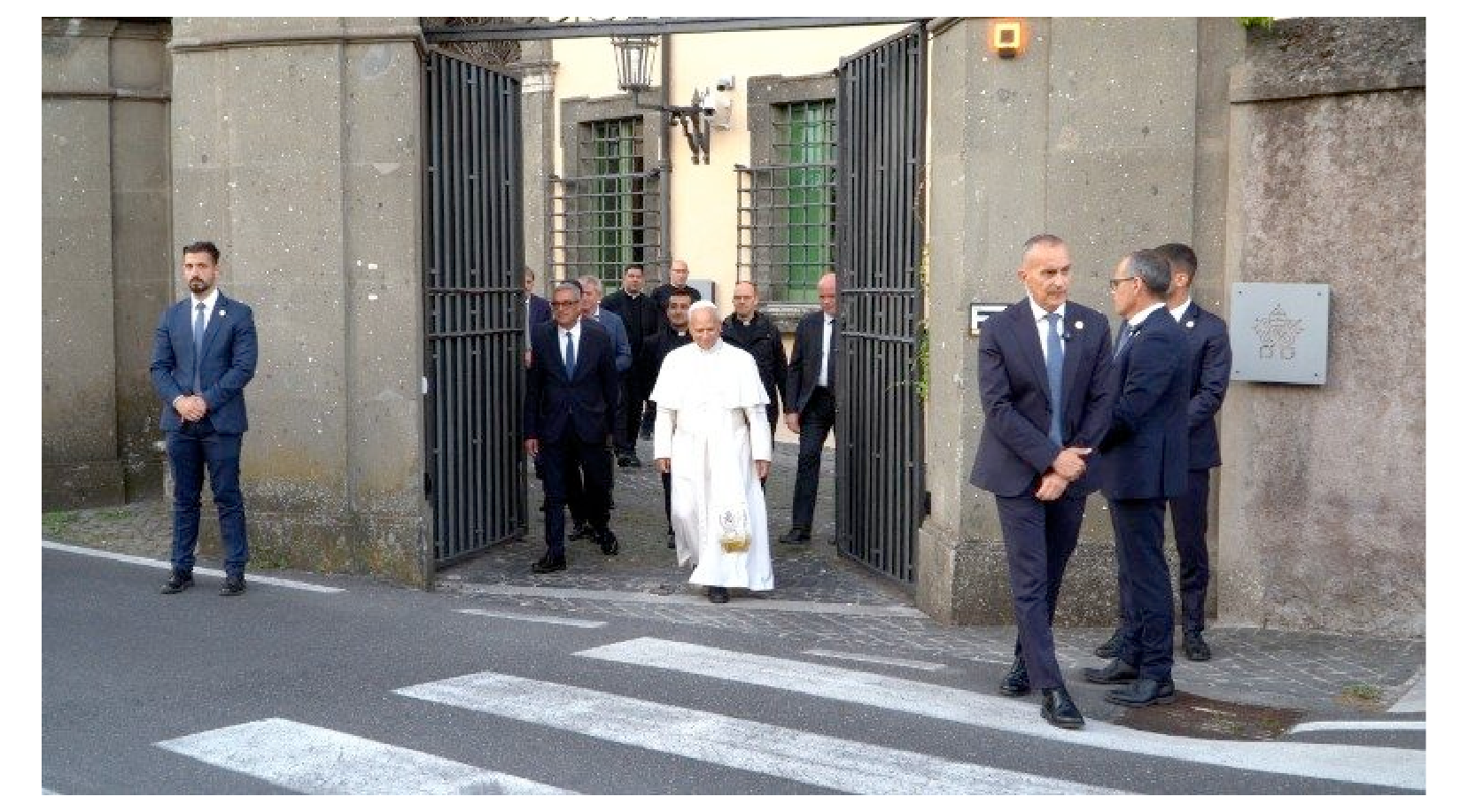
(ZENIT News / Castelgandolfo, 06.16.2026).- From migration and Church unity to international diplomacy and the prospect of future apostolic journeys, Pope Leo XIV offered a information during an informal yet substantive encounter with journalists outside Villa Barberini in Castel Gandolfo on June 16.
The conversation, held after a day devoted to work and rest at the papal residence, became an opportunity for the Pope to revisit the major themes that emerged during his recent visit to Spain while also addressing several issues shaping both ecclesial and global affairs.
Looking back on his journey across Spain, which included stops in Madrid, Barcelona and the Canary Islands, Leo XIV spoke with evident satisfaction about the reception he encountered. Rather than focusing on particular events or political significance, he emphasized the enthusiasm he witnessed among ordinary Catholics.
According to the Pope, what impressed him most was not a single gathering but the consistency of the welcome. He praised the extensive efforts of bishops, lay faithful and volunteers who prepared the events and described the overall atmosphere as one of genuine joy and participation.
His comments came at a time of heightened political tensions in Spain. Without entering into partisan debates, Leo XIV used the occasion to renew a theme that has become increasingly prominent in his public interventions: the need for dialogue. Societies, he suggested, cannot flourish when political opponents view one another primarily as enemies. Listening, seeking agreement and working for the common good remain indispensable elements of democratic life.
That same concern for human dignity shaped his remarks on migration, an issue he addressed repeatedly during his Spanish visit, particularly in the Canary Islands, one of Europe’s principal gateways for migrants arriving from Africa.
The Pope rejected simplistic approaches to what has become one of the continent’s most divisive debates. He urged governments and citizens alike to remember that migration is often driven by circumstances such as war, violence and instability rather than personal preference. While avoiding policy prescriptions, he insisted that responses must begin with recognition of the inherent dignity of every human being.
For Leo XIV, the Christian challenge lies not in ignoring legitimate social concerns but in resisting the temptation to treat vulnerable people as problems to be discarded. Every case deserves careful consideration, he argued, and every person deserves respect.
The Pope then broadened the discussion to international affairs, welcoming recent diplomatic progress between the United States and Iran. Referring to the Memorandum of Islamabad, reached following Pakistani mediation, he expressed hope that the agreement could become a genuine step toward ending conflict rather than merely postponing it.
His remarks reflected a longstanding Vatican conviction that even imperfect negotiations are preferable to renewed warfare. Leo XIV went further, linking the search for peace with broader concerns about nuclear disarmament and the social and economic wounds left by armed conflicts. The ultimate objective, he suggested, should not simply be the absence of fighting but the construction of conditions that allow peoples and nations to flourish.
One of the most delicate moments of the exchange concerned the Society of Saint Pius X. The traditionalist fraternity has announced its intention to proceed on July 1 with four episcopal consecrations without papal authorization, raising fears of a new rupture in relations with Rome.
The Pope revealed that the Holy See is still considering making a final appeal before the ceremony takes place. His words combined firmness and regret. While reiterating that the Society continues to reject key teachings associated with the Second Vatican Council, he stressed that division within Christianity is always a source of suffering.
The reference is particularly significant because the dispute with the Society of Saint Pius X is not primarily about liturgy, as is often assumed, but about deeper questions concerning ecclesiology, religious liberty, ecumenism and the authority of an ecumenical council. Leo XIV made clear that the Church’s desire remains reconciliation, yet he acknowledged that the final decision rests with the fraternity itself.
The conversation ended on a lighter note when journalists asked about his summer plans. The Pope spoke of reading, reflection and preparation for future responsibilities, while smilingly expressing hope that some genuine rest might also be possible.
Questions about possible future visits to Mexico and Peru—where he spent more than two decades as a missionary before his election—elicited an equally brief but suggestive response. With a smile, Leo XIV simply replied: “We shall see.”
The exchange lasted only a short time, but it offered a concise portrait of a pontiff seeking to hold together themes that have long challenged both the Church and the wider world. Leo XIV’s message from Castel Gandolfo was less about headlines than about a method—listening first, negotiating whenever possible, and never losing sight of the dignity of the human person.
Thank you for reading our content. If you would like to receive ZENIT’s daily e-mail news, you can subscribe for free through this link.

Publicaciones relacionadas:
 Pope Leo XIV Opens the Vatican Doors to the Only Orthodox Apostolate Accompanying Homosexual People to Live in Chastity
 Listening and Fasting: Lent as a Time of Conversion. This is what Pope Leo XIV’s first message for Lent 2026 says
 Trump Opens Another War Front: The Pope and the Vatican, Leo XIV Responds: «I Am Not Afraid of the Trump Administration»
 Pope Leo XIV calls the liturgy the “driving force of evangelization” and urges priests to respect liturgical texts and norms
