


(ZENIT News / Washington, 06.22.2026).- Four years after the Supreme Court’s landmark decision in Dobbs v. Jackson Women’s Health Organization overturned Roe v. Wade and returned abortion policy to the states, the political and moral shockwaves continue to shape American public opinion. Yet the latest polling suggests that the dramatic shift in attitudes that followed the ruling has now settled into a new and surprisingly stable equilibrium.
According to Gallup’s Values and Beliefs survey, conducted from May 1 to May 17, 2026, Americans are almost perfectly split on the legal status of abortion. Forty-eight percent believe abortion should be legal in all circumstances (33%) or most circumstances (15%), while 49% say it should either be legal only in certain circumstances (32%) or illegal in all cases (17%).
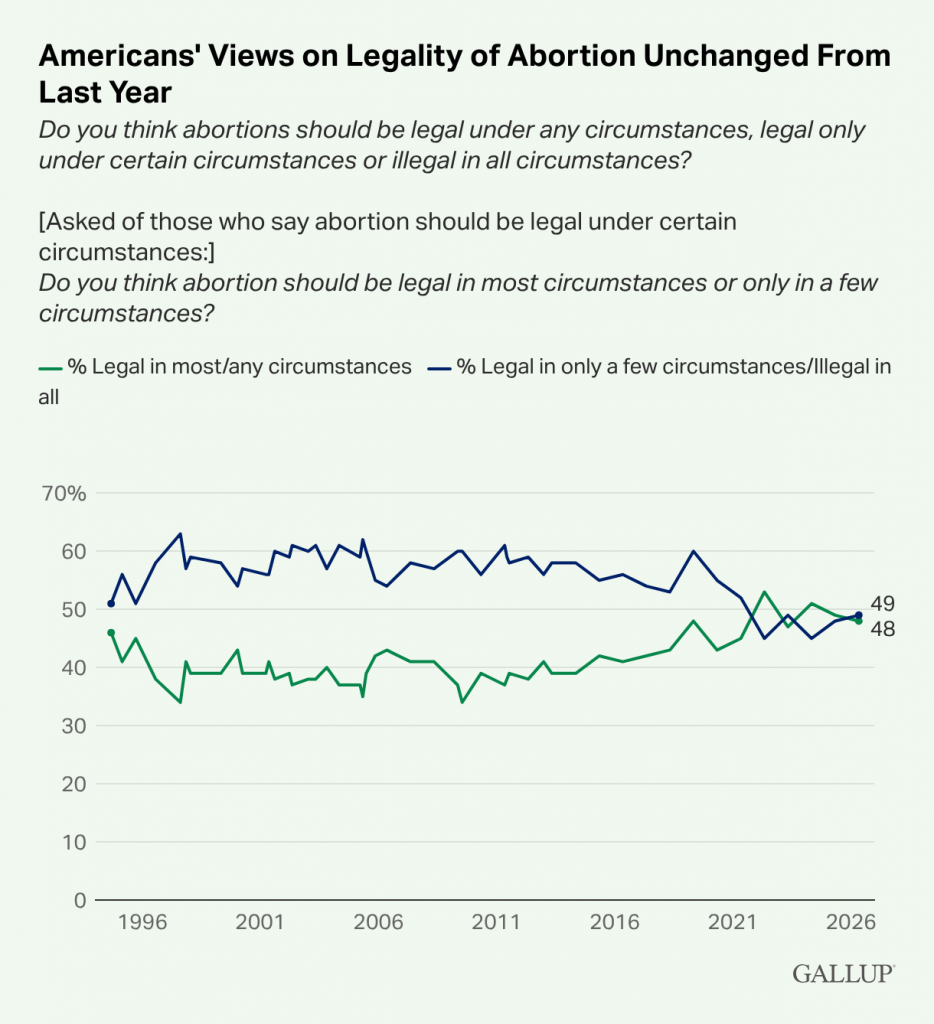
That near-even division marks a significant departure from the pattern that prevailed for roughly a quarter century before Dobbs. For many years, the dominant position among Americans was neither unrestricted access nor total prohibition, but a more restrictive middle ground in which abortion would be permitted only under certain conditions. Since 2022, however, public opinion has become more polarized, producing a country divided almost evenly between broader and narrower legal approaches.
The turning point came in the spring of 2022, when a draft of the Dobbs decision was leaked before the Court officially issued its ruling. In the months that followed, support for legal abortion reached levels Gallup had not previously recorded, with 53 percent favoring legality in all or most circumstances. While that initial surge has moderated slightly, it has largely endured.
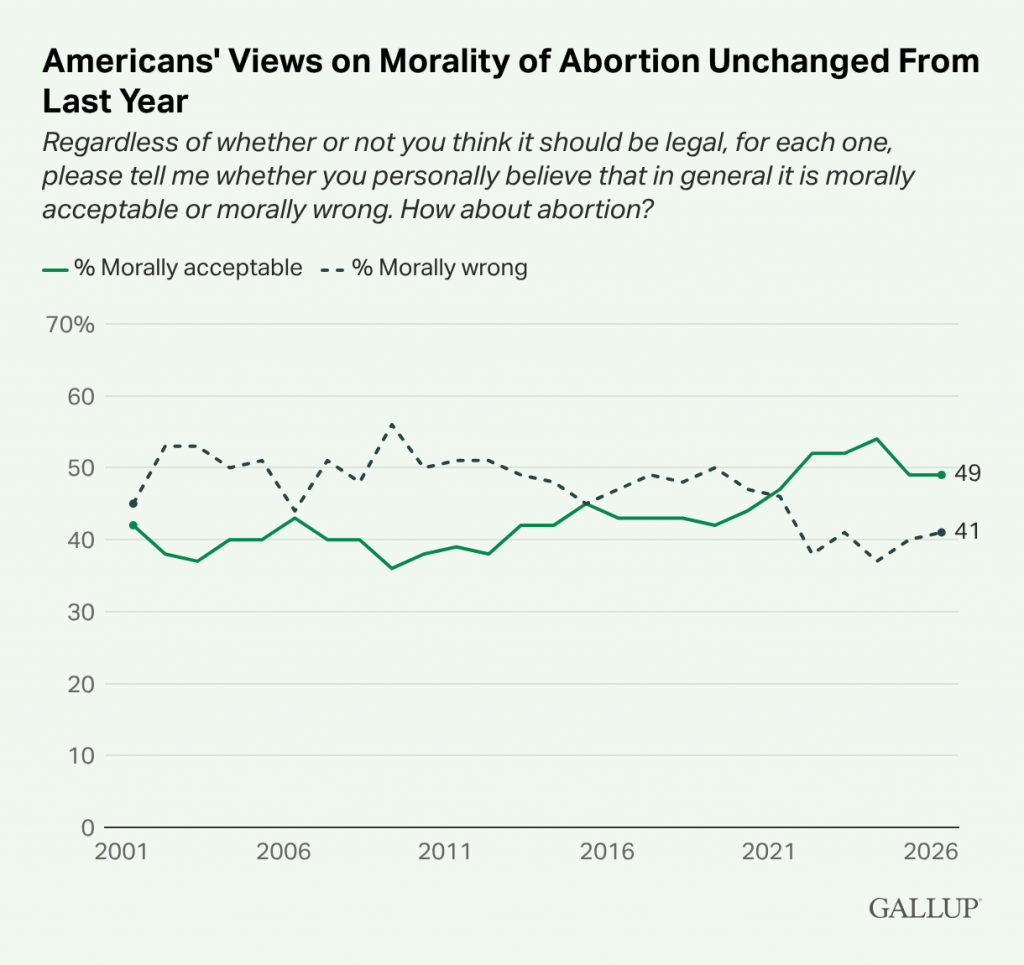
The same pattern is visible in Americans’ moral judgments. Nearly half of respondents today, 49 percent, say abortion is morally acceptable, compared with 41 percent who consider it morally wrong. Another 8 percent say the morality of abortion depends on the circumstances. Before Dobbs, Americans were almost evenly divided on the moral question; since then, those describing abortion as morally acceptable have consistently represented at least the largest single group.
The demographic fault lines remain striking. Women are considerably more supportive of legal abortion than men. Fifty-five percent of women say abortion should be legal in all or most cases, compared with 38 percent of men. A similar gap appears in moral evaluations: 56 percent of women regard abortion as morally acceptable, while only 39 percent of men share that view.
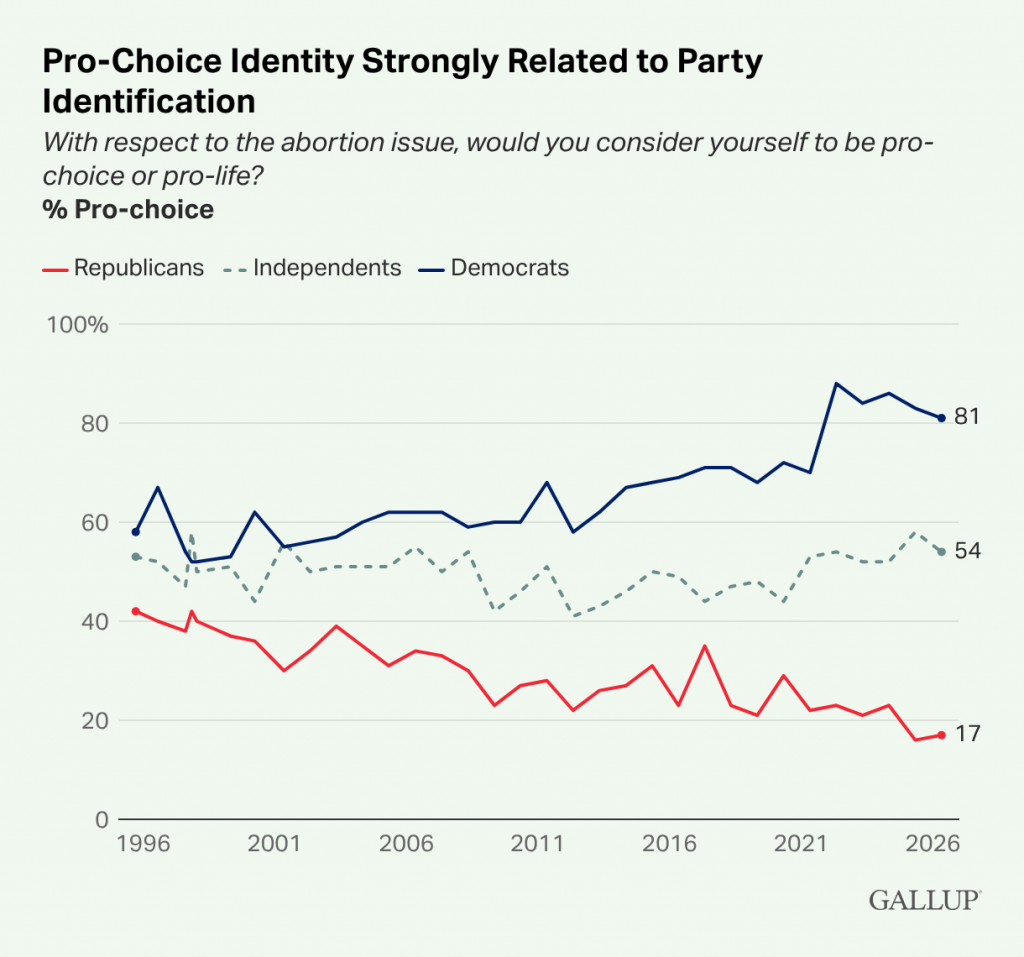
Political affiliation remains the strongest predictor of opinion. Three-quarters of Democrats favor broad abortion legality, compared with only 15 percent of Republicans. Independents are divided almost exactly down the middle. The moral dimension follows a nearly identical pattern, making abortion one of the most politically polarized issues in contemporary American life.
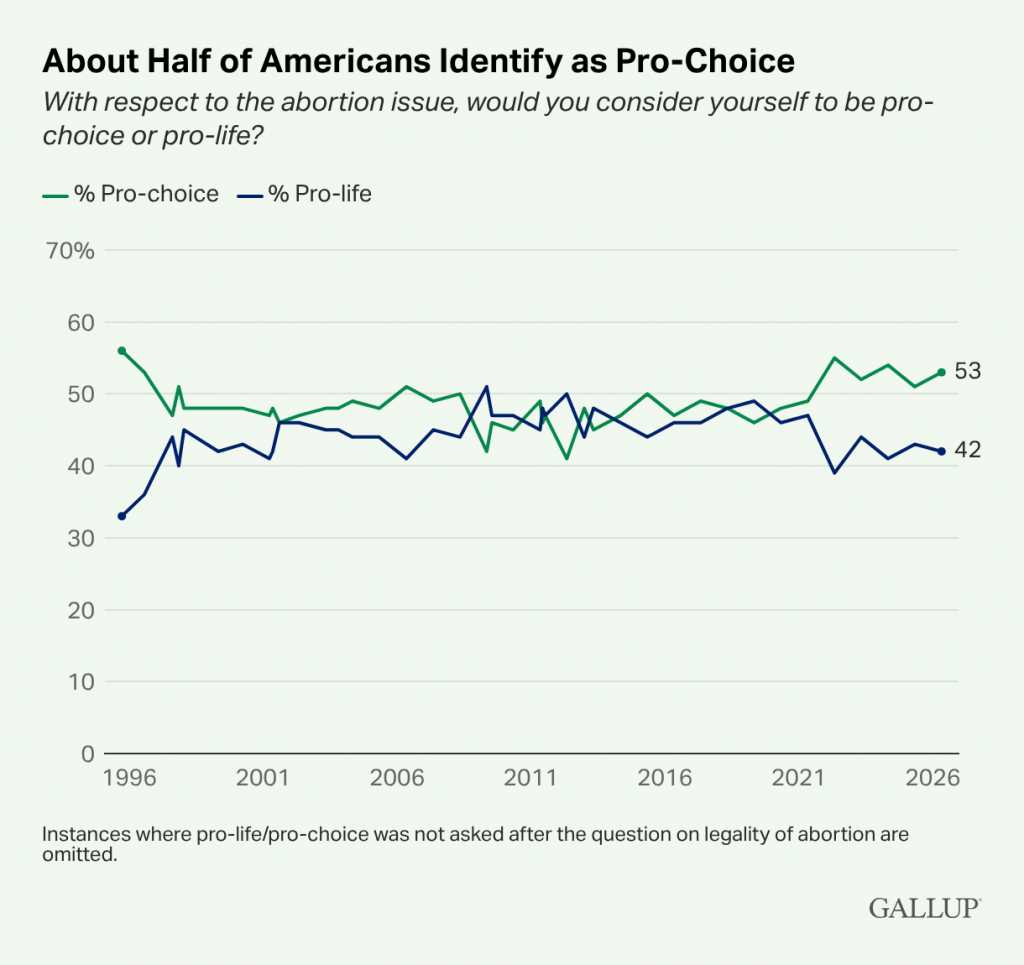
The debate is also reflected in how Americans describe themselves. Gallup reports that 53 percent now identify as «pro-choice,» while 42 percent identify as «pro-life.» The gap is not overwhelming, but it represents a notable change from the years between 2009 and 2021, when the two camps were often separated by only a few percentage points and occasionally reached parity.
For pro-life advocates, the findings present a mixed picture. While Dobbs achieved the long-sought legal objective of overturning Roe v. Wade, it did not produce a broad public movement toward more restrictive abortion views. At the same time, support for abortion remains far from unanimous, and nearly half the country continues to favor significant legal limits or outright prohibitions.
An important reality often overlooked outside the United States is that Dobbs did not ban abortion nationwide. Instead, it transferred authority over abortion regulation from the federal judiciary to elected lawmakers and voters in individual states. As a result, the country now operates under a patchwork of laws that vary dramatically by jurisdiction. Thirteen states currently enforce near-total abortion bans with limited exceptions, while others maintain some of the most permissive abortion policies in the Western world.
This decentralized landscape helps explain why the abortion debate remains so intense. Rather than settling the issue, Dobbs transformed it from a national constitutional dispute into a continuing state-by-state political contest.
Four years later, the most significant conclusion may be that the post-Dobbs shift has endured. The emotional reaction that followed the Supreme Court’s decision has not faded with time. Instead, it has become part of a new political reality in which Americans remain deeply divided—not only over what abortion law should be, but also over the moral questions that lie at the heart of the debate.
Thank you for reading our content. If you would like to receive ZENIT’s daily e-mail news, you can subscribe for free through this link.

Publicaciones relacionadas:
 Do women suffer from depression after their abortions?
 Planned Parenthood, Kamala Harris, and the Story of Victim David Daleiden
 UN Committee Challenges Selective Abortion Policies, Sparking Debate on Disability Rights
 U.S. Abortion Numbers Top 1.1 Million in a Year, But Gaps in Data Persist, New Study Finds
