

(ZENIT News / Rome, 03.05.2026).- As the Middle East plunges into one of its most dangerous escalations in years, Pope Leo XIV has raised his voice in a renewed appeal for peace, warning that the spiral of violence now unfolding could lead to a catastrophe of historic proportions.
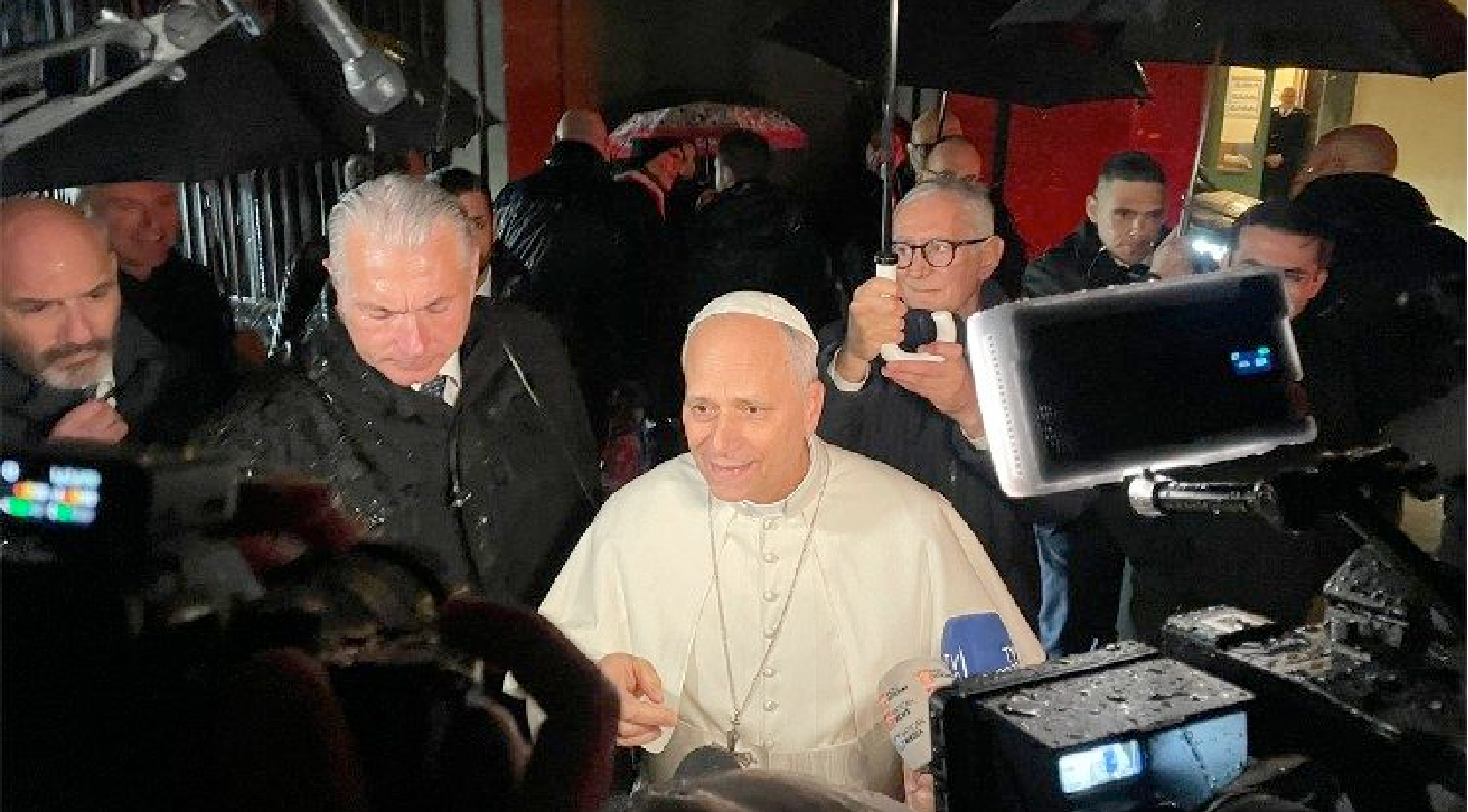
Speaking to journalists outside the papal residence of Castel Gandolfo on the evening of March 3, the pontiff delivered a brief but pointed message: the world must pray for peace and actively work to build it.
“Pray for peace. Work for peace,” the pope said. “There is too much hatred. Hatred in the world is constantly increasing.”
His words came as a U.S.-Israeli air campaign against Iran entered its fourth day and the conflict expanded across multiple fronts in the Middle East. What began with coordinated strikes against the Iranian regime on February 28 has rapidly evolved into a regional confrontation involving Israel, Iran, Gulf states, and armed groups operating throughout the region.
The consequences have been immediate and deadly. According to available reports, nearly 800 people have been killed in Iran since the beginning of the operations, while at least 11 people have died in Israel as Iranian retaliatory attacks intensified. Six American servicemen have also been confirmed killed.
The conflict has spread well beyond Iranian territory. Iran has launched attacks against targets in Bahrain, Qatar, the United Arab Emirates, Saudi Arabia, and Oman. Meanwhile, Israeli forces responded to strikes from Hezbollah in Lebanon with attacks in Beirut on March 3, raising fears that the fragile Lebanese front could ignite into full-scale war once again.
Even diplomatic and military infrastructure across the region has come under pressure. U.S. embassies in Dubai and Riyadh were reportedly targeted by drone attacks, signaling that the confrontation may increasingly draw in international actors.
The military escalation has also disrupted one of the world’s most critical economic arteries: the Strait of Hormuz. Nearly 20 percent of the global oil supply passes daily through the narrow waterway along Iran’s southern coast. Commercial shipping there has nearly halted as insurers have withdrawn coverage for vessels navigating the strait. Oil prices have surged, prompting the United States to consider deploying naval escorts for oil tankers transiting the region.
On March 3, U.S. President Donald Trump said the military campaign could last up to five weeks, while emphasizing that American forces have the capacity to sustain operations far longer. He also told the New York Post that he would not rule out deploying ground troops in Iran “if necessary,” a statement that further heightened international concern about the potential scale of the conflict.
For the Holy See, the danger lies not only in the current violence but in the logic of escalation itself. During the Angelus prayer on March 1, Pope Leo warned that the unfolding events could turn into “a tragedy of enormous proportions” if the parties involved fail to halt the cycle of retaliation.
“Stability and peace are not built through mutual threats,” he said on that occasion, “nor through weapons that sow destruction, suffering, and death, but only through a reasonable, authentic, and responsible dialogue.”
The pope urged leaders on all sides to assume what he called a “moral responsibility” to stop the spiral of violence before it becomes an irreparable abyss.
The Vatican’s diplomatic perspective on Iran is shaped by decades of cautious engagement. Relations between the Holy See and the Islamic Republic have often combined frank criticism with persistent dialogue, reflecting the distinctive method of Vatican diplomacy.
Tensions rose sharply in 2006 after Pope Benedict XVI’s famous Regensburg lecture, which included a historical quotation concerning religious violence that provoked widespread reactions across the Muslim world. Iranian authorities at the time accused the Vatican of fueling tensions between religions. Yet the crisis ultimately led to renewed dialogue between Catholic and Muslim scholars, including structured meetings between the Vatican’s Pontifical Council for Interreligious Dialogue and Iranian institutions.
That effort produced several high-level exchanges, including a 2010 visit to Tehran by Cardinal Jean-Louis Tauran, who delivered a personal message from Benedict XVI to then-president Mahmoud Ahmadinejad. In that letter, the pope emphasized the urgent need for cooperation among religious believers in promoting peace and defending universal ethical values.
The diplomatic relationship continued under Pope Francis, who broadened the Holy See’s engagement with the Middle East through what he described as a “culture of encounter.” In January 2016, Iranian President Hassan Rouhani visited the Vatican, where discussions with the pontiff included regional conflicts, nuclear negotiations, and the role religious leaders could play in countering extremism.
Francis’s historic trip to Iraq in March 2021 marked another milestone in Catholic dialogue with the Shiite world. In the city of Najaf, the pope met Grand Ayatollah Ali al-Sistani, one of Shiite Islam’s most influential authorities. The meeting symbolized a recognition of the pluralism within Islam and opened new possibilities for religious cooperation in a region often portrayed through rigid sectarian divisions.
That legacy of dialogue now forms the background against which Leo XIV’s appeals for peace must be understood. The Vatican has consistently sought to position itself as a moral voice capable of addressing all sides in a conflict without aligning with geopolitical blocs.
The human cost of the current war underscores the urgency of that message. In southern Lebanon, entire towns are already being emptied by fear of further escalation. In Sidon, roughly forty kilometers south of Beirut, residents have begun fleeing en masse after Israeli bombardments targeting Hezbollah positions. Traffic jams stretching for kilometers have paralyzed escape routes, leaving some communities trapped amid empty shops, closed schools, and growing shortages of food.
Local clergy report that Christian families, unable to leave due to road closures and congestion, now find themselves stranded as the broader population flees toward safer regions. The situation illustrates the complex social realities of Lebanon, where civilians of different religious communities often suffer the consequences of geopolitical confrontations they did not choose.
In this climate of uncertainty and fear, the pope’s words have taken on particular resonance. Speaking again to journalists at Castel Gandolfo before returning to the Vatican, Leo XIV reiterated the core of his message.
“Let us pray that there will be less hatred and more peace,” he said. “And let us truly seek dialogue.”
For the Holy See, that appeal is not merely rhetorical. It reflects a long-standing conviction, expressed repeatedly by recent popes, that war ultimately represents a failure of politics and a collapse of humanity’s capacity for reason.
As the Middle East faces the prospect of a broader regional war, the Vatican’s hope remains that diplomacy — not missiles — will ultimately shape the future of the region.
Thank you for reading our content. If you would like to receive ZENIT’s daily e-mail news, you can subscribe for free through this link.

Publicaciones relacionadas:
 Pope Leo’s visit to Argentina unofficially confirmed after audience with President Milei
 US Congress: bill introduced to prevent revocation of Pope Leo XIV’s citizenship and tax issues
 A Church Against the Logic of War: Vatican Voices, Middle East Realities, and the Risk of a Vanishing Christianity
 Pape Leo Spoke On The Phone With Vladimir Putin: This Is What Their Conversation Was About
