

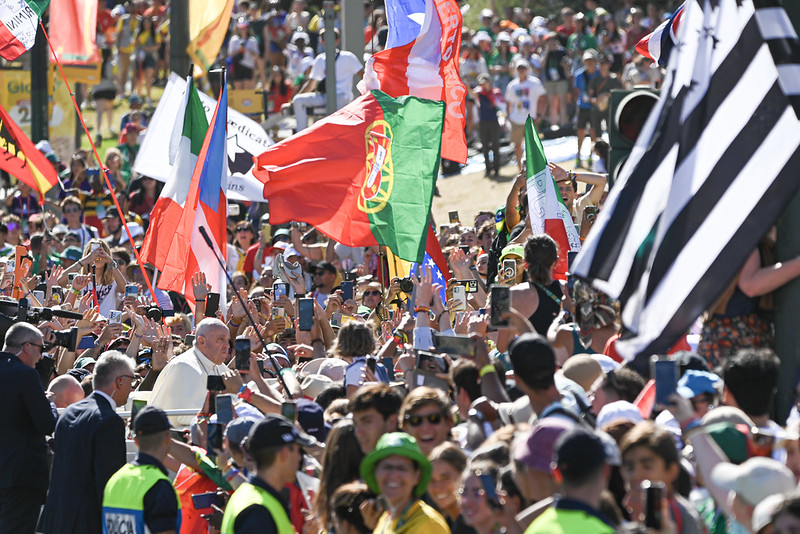
(ZENIT News / Atlanta, 04.09.2026).- The quiet channels of the Vatican are often where the future geography of global Catholicism is decided. In recent months, one such conversation has taken on increasing weight: the proposal by the Archdiocese of Atlanta to host the 2030 edition of World Youth Day, an event that regularly draws hundreds of thousands—sometimes more than a million—young pilgrims from across the world.
If successful, the bid would do more than bring a major ecclesial gathering to the American South. It would almost certainly ensure the first visit to the United States by Pope Leo XIV, a pontiff whose nationality has already reshaped expectations about the Vatican’s global posture. It would also mark only the second time the United States has hosted the event, following the landmark 1993 edition in Denver.
Behind the proposal is bishop Gregory Hartmayer, who began exploratory discussions with Vatican officials in late 2025 and has since worked to consolidate both ecclesial and civic backing. His interlocutors in Rome include Kevin Farrell, whose office plays a central role in overseeing the international dimensions of the gathering. According to sources familiar with the process, the archbishop has spent months assembling a coalition that extends well beyond Church structures, drawing in political authorities and business leaders—an essential step in any credible World Youth Day candidacy.
The scale of the undertaking explains why. Contemporary editions of World Youth Day are complex logistical ecosystems. The local Church is expected to provide not only liturgical organization but also accommodation networks, transportation systems, security coordination, and large-scale venues capable of hosting papal events that culminate in an open-air vigil and Mass. Atlanta’s proposal reportedly follows the standard model: pilgrims housed in parishes across a wide metropolitan area, commuting daily toward central gathering points.
Such ambitions are rooted in a broader demographic shift. With approximately 1.2 million Catholics, the Archdiocese of Atlanta has become one of the fastest-growing Catholic jurisdictions in the United States. Since 2000, its Catholic population has expanded by roughly 400 percent, mirroring the wider growth of the metropolitan region, which has added more than 1.5 million residents in the same period. In ecclesial terms, this reflects a well-documented انتقال of Catholic vitality from the historic northeastern strongholds toward the southern and western United States—a transformation driven by migration, economic opportunity, and changing cultural patterns.
Hosting World Youth Day would, in that sense, be both a recognition and an acceleration of that تحول. The precedent of Denver remains instructive. The 1993 gathering, presided over by John Paul II, is widely credited by Church historians with consolidating the global profile of World Youth Day and energizing Catholic life in the United States. Vocations, lay movements, and missionary initiatives all experienced a measurable surge in its aftermath. The event’s central message—a call to young people to build a “culture of life”—became one of the defining themes of the late pontificate.
Since then, World Youth Day has evolved into one of the Church’s most visible instruments of global engagement, held every two to four years and moving across continents. The most recent edition took place in Lisbon in 2023, while the next is scheduled for Seoul in 2027. As is customary, the host city for 2030 is expected to be announced at the conclusion of the Seoul gathering, following internal Vatican deliberations.
Yet the Atlanta bid introduces a layer of strategic complexity. Papal travel is planned years in advance and involves significant diplomatic and logistical investment. Church officials on both sides of the Atlantic have indicated that organizing a first papal visit by Leo XIV to his homeland would already require extensive preparation. The prospect of aligning that visit with a World Youth Day could streamline those efforts—but it would also make it unlikely that the pope would travel to the United States in the immediate years prior.
Financial considerations further illustrate the scale of the proposal. While no official budget has been disclosed, recent national Catholic events offer a point of comparison: the 2024 National Eucharistic Congress in the United States raised more than 14 million dollars for a gathering of approximately 50,000 participants. World Youth Day operates on a vastly larger scale, often exceeding one million attendees, and requires a level of coordination that blurs the line between ecclesial event and global summit.
For Atlanta, the bid is therefore as much a test of institutional capacity as it is a statement of ecclesial identity. It signals a Church that sees itself no longer on the periphery of American Catholic life, but at its emerging center of gravity. For the Vatican, the decision will involve balancing geography, symbolism, and practical feasibility.
What remains uncertain is whether this southern metropolis—dynamic, expanding, and religiously diverse—will be entrusted with hosting one of the Church’s most consequential global encounters. What is clear is that the conversation itself reflects a deeper shift: the map of Catholicism in the United States is being redrawn, and Atlanta intends to be at its forefront.
Thank you for reading our content. If you would like to receive ZENIT’s daily e-mail news, you can subscribe for free through this link.

Publicaciones relacionadas:
 Impressive: nearly 2,000 young Iraqi Catholics celebrate faith in the midst of a Muslim community
 Northern Ireland’s Youth Spark Unexpected Religious Revival
 Surprising research data among French clergy: the younger they are, the more conservative… and happy they are
 What a survey in Germany reveals: Youth Interest Rises as Catholics Distance Themselves from the Synodal Way
