

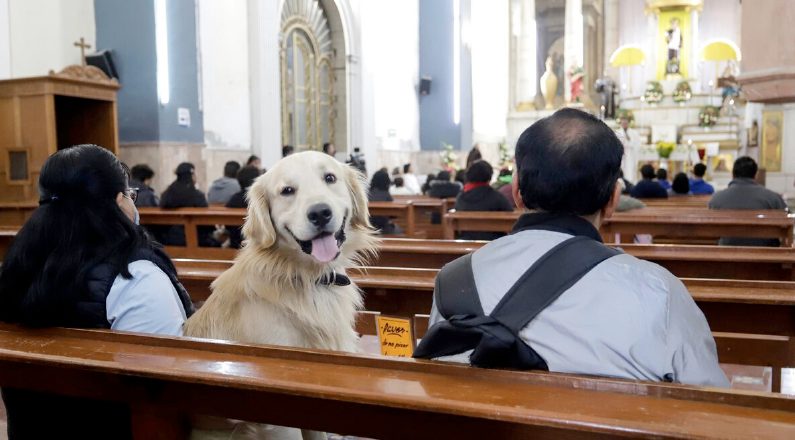
(ZENIT News / Chur, 04.30.2026).- What happened in a Zurich parish on an autumn day in 2025 might have remained a local incident, quickly forgotten. Instead, months later, it has become a case study in how the Catholic Church navigates the boundary between doctrinal clarity and pastoral judgment, particularly when the heart of the faith—the Eucharist—is involved.
The Diocese of Chur announced on April 17, 2026, that three Catholics who shared fragments of Consecrated Hosts with their dogs during a mass celebration did not incur excommunication. The reason, according to the diocesan investigation, was decisive: the absence of sacrilegious intent.
The episode took place on October 4, 2025, at the Good Shepherd parish in Zurich, during an event that combined a blessing of animals with a Mass. Due to unfavorable weather forecasts, the outdoor blessing was moved inside the church and incorporated into the Eucharistic celebration. Three participants gave portions of the Eucharistia they had received to their animals.
The gesture triggered a formal inquiry led by Bishop Joseph Maria Bonnemain. The central question was not whether the act had occurred—it had—but whether it constituted sacrilege in the strict sense defined by canon law.
The Church’s legal framework on this matter is precise. Canon 1382 §1 establishes that anyone who discards the consecrated species, takes them for a sacrilegious purpose, or retains them with such intent incurs automatic excommunication, a penalty so severe that only the Holy See can lift it. This type of sanction, known as latae sententiae, is incurred by the very commission of the act, without the need for a formal declaration.
Yet the law also requires a subjective element: intention. Without it, the external act, however inappropriate, may not meet the threshold of a canonical crime. This principle proved decisive in Chur. According to the diocesan statement, the investigation “clearly demonstrated” that the individuals involved did not act with sacrilegious intent and therefore could not be accused of sacrilege in the juridical sense.
The distinction is not merely technical. In Catholic theology, the Eucharist is not a symbol but the real presence of Christ under the appearances of bread and wine. For that reason, any deliberate act of profanation is treated with the utmost gravity. At the same time, the Church has long recognized that moral responsibility depends not only on the act itself but also on knowledge and intention.
Canon law explicitly states that a person who violates a law without awareness or culpability cannot be punished in the same way as one who acts with full knowledge and consent. However, it also cautions that certain forms of ignorance—described as gross or willful—do not necessarily excuse responsibility. The evaluation of such factors often requires careful pastoral discernment.
In its conclusion, the Diocese of Chur described the incident as “deeply regrettable,” even while ruling out canonical penalties. Bishop Bonnemain has since convened a meeting with parish staff to reflect on the Eucharist in light of Pope Francis’ apostolic exhortation on the liturgy, Desiderio Desideravi, a text that emphasizes the need for renewed reverence and understanding of the sacramental mystery.
The response has not fully settled the matter. Some observers, including the Swiss Catholic platform SwissCath, have raised questions about the investigation itself, particularly regarding its independence and scope. The inquiry was entrusted to a figure described as close to the bishop, prompting concerns about impartiality.
Critics also argue that the diocesan report leaves unresolved a crucial issue: whether the pastoral organization of the event may have created ambiguity that facilitated the misuse of the Eucharist. The reconstruction of the day’s events has been described as inconsistent, with differing accounts about whether the Mass was planned in advance or added at the last minute.
The unease surrounding the incident is reflected in the reaction of the faithful. On January 3, a group of approximately 40 lay Catholics gathered in the same parish to pray a rosary of reparation, a traditional practice in the Church intended to express sorrow and restore a sense of reverence after perceived offenses against the sacred.
The controversy also unfolds within a broader context that has already placed the Diocese of Chur under scrutiny. Bishop Bonnemain, appointed in 2021, has faced criticism on several fronts, including a proposed code of conduct for clergy that some priests argued would limit their ability to teach Catholic doctrine on sexuality and to fulfill their responsibilities in pastoral care and confession. More than 40 priests declined to sign the document.
Complicating matters further are changes in Swiss legal frameworks. In the canton of Zurich, where the diocese operates, new labor regulations mean that Church employees can no longer be dismissed solely for dissenting from certain moral teachings. This development reflects the unique legal status of religious institutions in Switzerland, where they are subject to public law in ways that differ from many other countries.
Thank you for reading our content. If you would like to receive ZENIT’s daily e-mail news, you can subscribe for free through this link.

Publicaciones relacionadas:
 Against the Pope’s Will, Belgian Bishops Led by Cardinal Jozef De Kesel Approve “Catholic Blessing” of Gay Couples
 Vandal Decapitates Statue of Infant Jesus at New York Parish
 Who is the person appointed bishop by the Pope who also becomes prince of a country?
 U.S. bishops to discuss impact, opportunities, and challenges of artificial intelligence at November plenary meeting
