

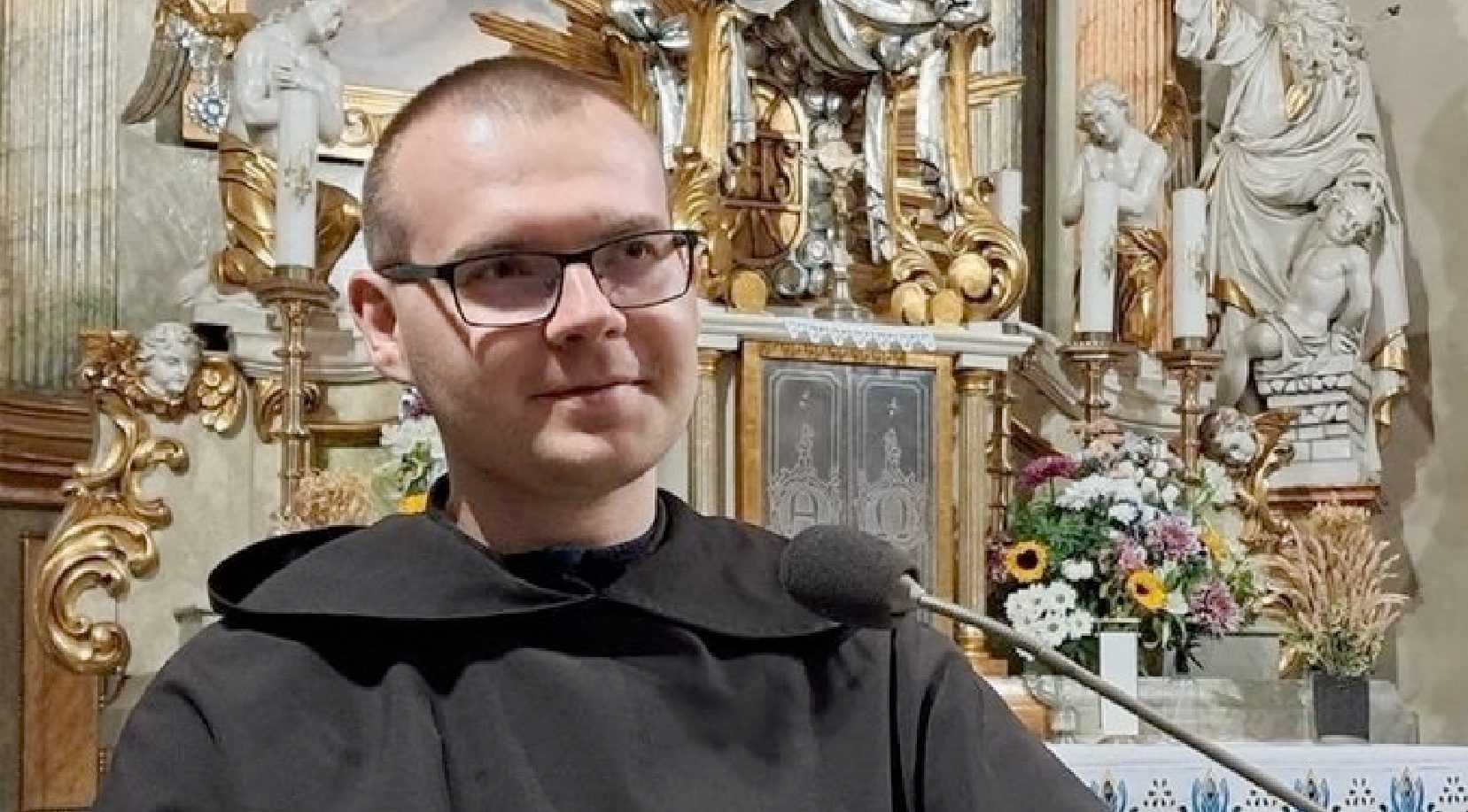
(ZENIT News / Warsaw, 05.01.2026).- The image of a young friar emerging from detention, silent and in need of rest, stands in stark contrast to the geopolitical machinery that secured his freedom. On April 28, 2026, Brother Grzegorz Gawel, a Discalced Carmelite from Poland, was released in Belarus as part of a complex international prisoner exchange—an operation involving multiple countries, intelligence services, and months of negotiation.
At 28 years old, having professed his solemn vows only weeks before his arrest, the friar now returns to a life abruptly interrupted. His religious community has confirmed that he is in good health, though deeply marked by the experience, and in need of time to recover after what they describe as a difficult ordeal.
Gawel’s detention began on September 4, 2025, in the northern Belarusian town of Lyepyel, where he was apprehended by agents of the state security services. Footage broadcast by official media showed masked officers forcing him to the ground, pressing his face into the dirt, and restraining him with his hands behind his back. His glasses fell off in the process, and his expression appeared confused as he was confronted with accusations of espionage.
Authorities claimed he possessed a confidential document related to the joint Belarusian-Russian military exercise “Zapad 2025,” conducted between September 12 and 16. They also reported that he was carrying cash in multiple currencies and a local SIM card. Alongside these items were objects more consistent with his vocation: a rosary, prayer books, and devotional images.
From the outset, Polish officials rejected the allegations. A spokesperson for Poland’s special services described the arrest as a provocation, stating bluntly that intelligence agencies do not deploy monks to gather military information. Human rights groups, including the Belarusian organization Viasna, later recognized Gawel as a political prisoner.
His release came within a broader exchange described as a “5-for-5” format, involving individuals convicted of espionage or related offenses in Belarus and Russia being swapped for detainees held in European Union countries and elsewhere. In total, 10 prisoners were involved across multiple jurisdictions.
Among those freed alongside Gawel was Andrzej Poczobut, a prominent journalist and member of the Polish minority in Belarus, who had been serving an eight-year sentence widely regarded as politically motivated. Arrested in 2021 after covering pro-democracy protests, Poczobut had become a symbol of resistance to authoritarian rule. Upon his release, he appeared visibly weakened, having lost more than 19 kilograms during his imprisonment, and was immediately taken for medical evaluation.
The exchange also included figures connected to intelligence services from Moldova and Russia, as well as individuals accused of activities ranging from treason to illegal excavations in occupied Crimea. The operation required coordination among at least seven countries and was facilitated, according to Polish and American officials, by diplomatic engagement involving the United States, Romania, and Moldova.
Polish Prime Minister Donald Tusk personally welcomed the released detainees at the border crossing with Belarus, describing the negotiations as both “complicated and sensational.” He acknowledged that a previous attempt to secure Poczobut’s release had collapsed less than 24 hours before completion, underscoring the fragility of such arrangements.
For Belarus, the exchange appears to form part of a broader effort to recalibrate its relations with Western nations after years of isolation. President Alexander Lukashenko, who has ruled the country of approximately 9.5 million people for more than three decades, has faced sustained criticism and sanctions over human rights violations and his alliance with Russia, particularly following the 2020 presidential election and the subsequent crackdown on mass protests.
That repression has been extensive. More than 65,000 people were arrested in the aftermath of the disputed election, with widespread reports of police violence, prolonged detentions, and forced exile. According to Viasna, at least 832 political prisoners remain in Belarusian jails today.
Within this context, the detention of clergy has not been an isolated phenomenon. Following the 2020 unrest, several Catholic priests were arrested, reflecting the vulnerability of religious figures in a society where faith communities often play a role in preserving cultural and moral identity. Two such priests were released in November 2025, in what observers linked to renewed diplomatic contacts involving the Vatican and the United States.
The Catholic dimension of Gawel’s case is therefore significant. As a member of the Discalced Carmelites—a contemplative order—his arrest on espionage charges struck many as implausible. His superiors in Poland called for prayers immediately after his detention, entrusting his situation to the intercession of Our Lady of Mount Carmel.
His personal trajectory underscores the abruptness of the ordeal. Born in Rzeszów, he entered the Carmelite Order in 2018, made his first vows in 2020, and pronounced his perpetual vows on March 19, 2025, in Krakow. Within months, he found himself at the center of an international dispute.
The presence of a Polish minority—estimated at around 300,000 people, or roughly 3 percent of Belarus’s population—adds another layer of complexity, intertwining national identity with religious affiliation.
The liberation of Brother Gawel has been greeted with relief and gratitude by his community, which thanked both ecclesiastical and civil authorities for their efforts. Yet the sense of closure is incomplete. His case, like that of many others, points to a reality in which freedom can depend less on justice than on negotiation, and where the fate of individuals is often tied to calculations beyond their control.
Thank you for reading our content. If you would like to receive ZENIT’s daily e-mail news, you can subscribe for free through this link.

Publicaciones relacionadas:
 UNESCO puts Gaza’s ancient Christian monastery on ‘danger list’
 Zaragoza’s Basilica of the Pillar Marks Record-Breaking Global Pilgrimage Surge: Americans are the largest group
 PHOTO GALLERY: Amidst the war, a beautiful new Catholic basilica is blessed and inaugurated in Ukraine
 150,000 People Have Already Registered to See the Mortal Remains of St. Francis of Assisi
