

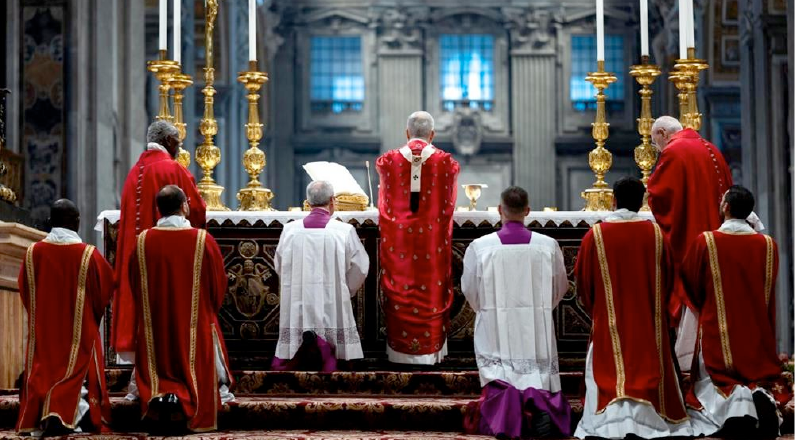
(ZENIT News / Rome, 06.23. 2026).- Below is a translation of the letter in which the Prefect of the Dicastery for Divine Worship and the Discipline of the Sacraments, Cardinal Arthur Roche, responds to the President of the German Bishops’ Conference, Heiner Wilmer, who requested a dispensation allowing lay people to preach homilies in Germany. Although the Holy See made its refusal public on June 23, the letter is dated six days earlier.
* * *
Vatican City, June 17, 2026
Your Excellency,
I have received your letter of March 30, 2026, in which Your Excellency, on behalf of the German Bishops’ Conference, submitted to this Dicastery for consideration a request for an indult that, in exceptional cases, would permit a homiletic contribution by a layperson following the proclamation of the Gospel during the Eucharistic Celebration.
First of all, I wish to express my sincere gratitude for the pastoral concern that underlies this request and for the desire to ensure adequate spiritual care for the faithful entrusted to your care.
The requested indult concerns the provision of canon 767 § 1 of the Code of Canon Law, according to which the homily, as an integral part of the liturgy, is reserved to a priest or deacon. This norm has been repeatedly reaffirmed by the Magisterium, particularly in the Instruction Redemptoris Sacramentum (nos. 64-66), which expressly excludes the possibility of lay faithful delivering the homily during the celebration of Mass, even under another name.
This provision is not merely disciplinary in character, but reflects a reality intimately linked to the theological and liturgical nature of the homily. As a specific act of the Liturgy of the Word, it is inseparably linked to the proclamation of the Gospel and to the presiding minister of the celebration, and constitutes a specific exercise of the munus docendi entrusted to the ordained minister.
This responsibility of the ordained minister is rooted in the very essence of the sacred liturgy, which is not merely an occasion for instruction, but the privileged place where the faithful are introduced into the mystery of Redemption. As Pope Leo XIV recently pointed out during the General Audience of May 29, 2016: “The liturgy sustains the faithful by immersing them again and again in the Lord’s Passover; thus, through the proclamation of the Word, the celebration of the Sacraments, and common prayer, they are refreshed, encouraged, and renewed in their faith and in their mission.”
Since the reservation of the homily to the ordained minister belongs to the sacramental and liturgical structure of the Eucharistic Celebration itself, no dispensation from the norm established in canon 767 § 1 can be granted by indult, not even in the presence of grave pastoral considerations.
The proclamation of the Word of God in the liturgical assembly is inseparable from a mission received within the Church (Catechism of the Catholic Church, no. 875). This ecclesial mission is expressed sacramentally through sacred ordination. Canon 1009 § 3, modified by Pope Benedict XVI in the Motu Proprio Omnium in Mentem, states: “Those who have received the episcopate or the priesthood receive the mission and the faculty to act in the Person of Christ Head; deacons, on the other hand, receive the power to serve the People of God in the diakonia of the liturgy, of the Word, and of charity.” This distinction does not establish inequalities among the baptized, but rather reflects the diversity of gifts and ministries within the one Body of Christ (cf. 1 Corinthians 12:18-19).
Word and Sacrament are inseparable in the Eucharistic Celebration. Consequently, the proclamation of the Word within the framework of the liturgical action, and especially the homily, belongs to the minister ordained by virtue of the Sacrament of Holy Orders and cannot be delegated. For this reason, the General Instruction of the Roman Missal clearly establishes: «In principle, the homily must be delivered by the celebrant priest, or may be entrusted by him to a concelebrating priest, or on some occasions, if it is appropriate, to a deacon, but never to a layperson:» (GIRM, n. 66).
Consequently, criteria such as better theological preparation or greater communicative abilities on the part of the lay faithful, however valuable they may be in themselves, cannot justify entrusting them with the homily, without prejudice to the provisions of canon 766. Nor is it a mere question of theological competence. For the priest, the preparation and proclamation of the homily constitute an integral part of his priestly ministry and spirituality, and cannot be separated from them.
In this context, it is significant that Pope Francis, in Desiderio Desideravi, no. 36, describes the ministry of ordained priests «Sunday after Sunday» precisely as that of introducing the faithful to the mystery. Celebrated in the liturgy: «Ordained ministers perform a profoundly important oral action when they take the baptized faithful by the hand to lead them to the repeated experience of the Paschal Mystery.»
At the same time, it is important to recognize the real challenges that frequently affect the quality of homiletic preaching. These should be an incentive for a renewed commitment to initial and ongoing formation, so that the homily may fully unfold its «almost sacramental character» (cf. Evangelii Gaudium, n. 142).
In light of these considerations, the proposed distinction between a «homily,» reserved for the ordained minister, and a possible «preaching,» entrusted to a layperson, is not admissible, since the proposed place — immediately after the Gospel — and the function exercised substantially coincide with those of the homily itself.
On the other hand, the current situation does not appear to constitute an emergency or a genuine pastoral need that would justify a deviation from a norm so closely linked to the nature of the liturgical act. In fact, where a priest is present for the Celebration of the Eucharist, he is also present to exercise the ministry of the homily that corresponds to him by virtue of his ordination. Situations in which the Celebrant is impeded — for example, due to a temporary physical impairment — constitute only occasional and time-limited circumstances, and cannot be invoked as the basis for a permanent pastoral need. Conversely, where there is no priest available, the Eucharistic Celebration does not take place; rather, in accordance with Church norms, provision is made for celebrations of the Word of God, within which appropriate forms of proclamation or interpretation of Sacred Scripture may be entrusted to the faithful without requiring a special indult.
It should also be noted that current norms already provide for forms of proclamation that may be entrusted to the lay faithful outside of the homily and the Eucharistic Celebration (cf. canon 766 CCC) and that may be promoted according to the needs of the particular Churches.
In this respect, it may be useful to recall that the Code of Canon Law, while not containing an exhaustive catalog of such forms of proclamation, both its structure and ecclesial practice clearly foresee a wide range of possibilities that are already fruitfully present in the life of the Church. Among them are, for example, catechesis (cf. canon 774 § 1), religious teaching, spiritual conferences or theological seminars, days of retreat and Spiritual Exercises, as well as testimonies or various pastoral meetings. Similarly, forms of proclamation such as reflections, exhortations, or catechetical instructions, when used within the context of celebrations consisting exclusively of the Liturgy of the Word — for example, Sunday celebrations in the absence of a priest, celebrations of the Word of God, penitential celebrations, or similar assemblies — do not constitute an exception to the current discipline for the homily, but rather represent an application of the broader canonical provisions regarding proclamation.
In this context, the diocesan Bishop may, in accordance with canon 772 § 1, establish the appropriate circumstances for such forms of proclamation. However, he cannot dispense with the norm that reserves the homily to ordained ministers (cf. canon 767 § 1; Pontifical Commission for the Authentic Interpretation of the Code of Canon Law, May 26, 1987, AAS 79 [1987], 1249). The lay faithful may not preach during the Eucharistic Celebration in the place designated for the homily.
The lay faithful can contribute valuably to the life of the Church and the proclamation of the Gospel in many ways, including collaboration in the preparation of homilies and in other forms of catechesis and evangelization. Such collaboration, when properly fostered, enriches the ordained ministers themselves and at the same time respects the proper values of each state of life.
The preceding considerations confirm that the reservation of the homily to the ordained minister within the context of the Eucharistic Celebration derives from the sacral and liturgical character of the act itself, as well as from the specific responsibility conferred by sacred ordination for the proclamation of the Word in the sacred liturgy. For this reason, no dispensation can be granted by indult from the norm established in canon 767 § 1.
With the assurance of my highest regards, I remain,
Your most devoted servant in the Lord
Arthur, Cardinal Roche
Prefect

Publicaciones relacionadas:
 10 short questions and answers on the Instrumentum Laboris for the Synod on Synodality 2024
 Vatican Clarifies US Holy Day Obligations, Raising Questions About USCCB’s Policy
 Vatican Limits Traditional Latin Mass in Texas Diocese Following Bishop’s Removal
 The Vatican Rejects German Bishops’ Request to Allow Laypeople to Deliver Homilies: Here’s Why
