

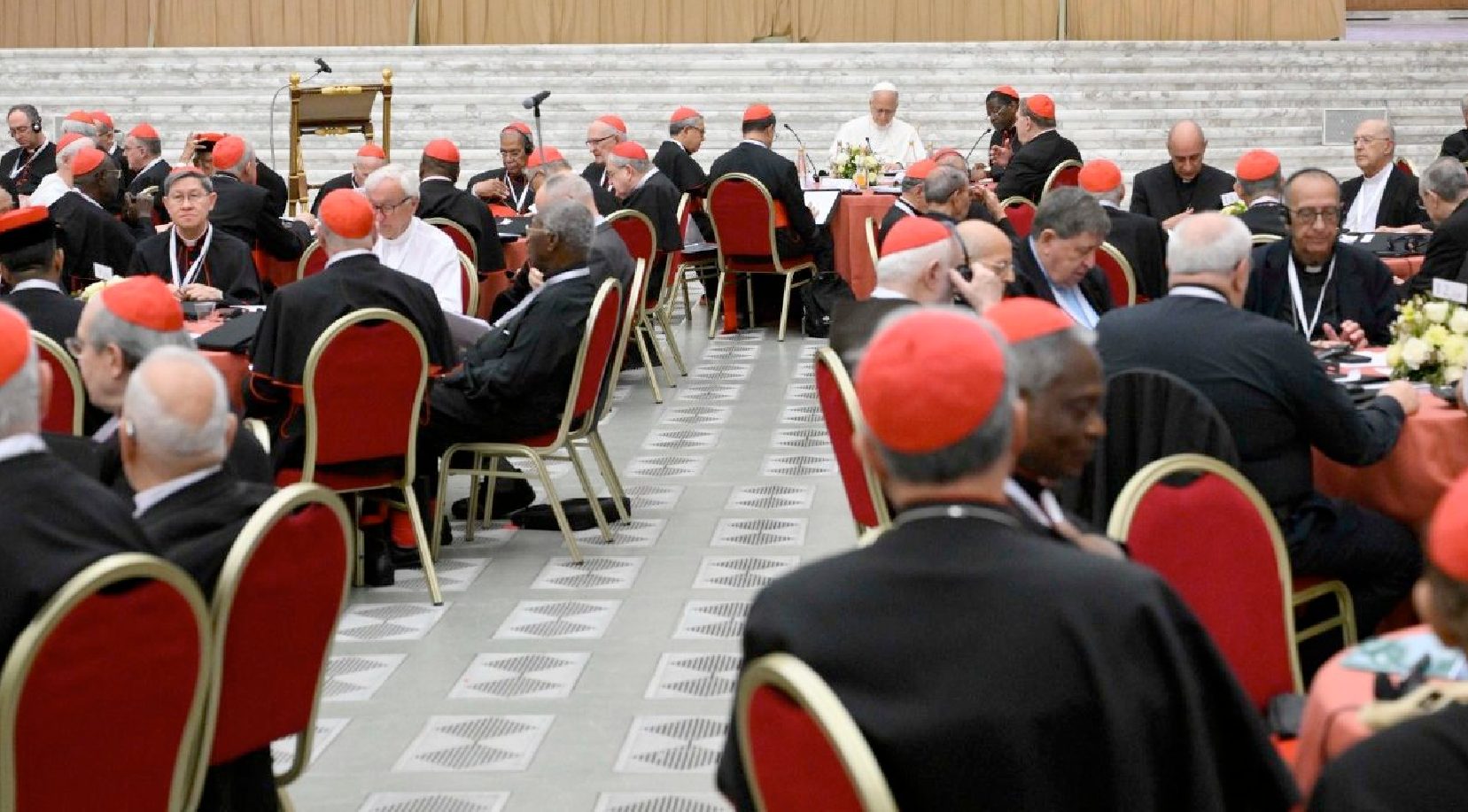
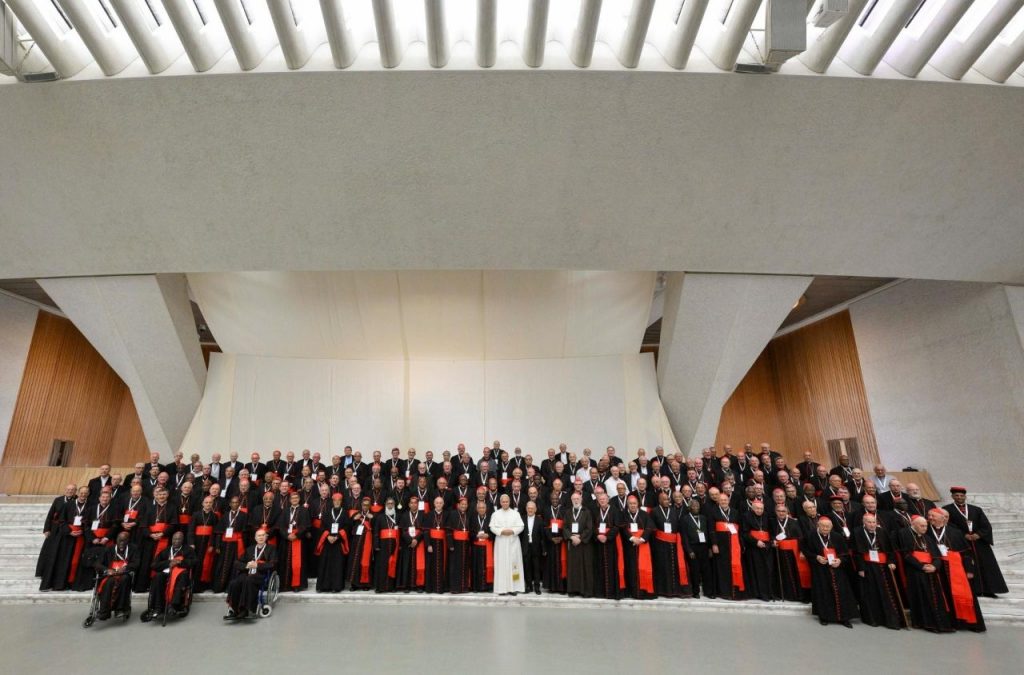
(ZENIT News / Vatican City, 06.27. 2026).- Following the Holy Mass celebrated by Cardinal Giovanni Battista Re at 9:30 a.m. on Saturday, June 27, the Cardinals gathered in Paul VI Hall for the third session of the Consistory, moderated by Cardinal Laurean Rugambwa. Pope Leo XIV led the Adsumus prayer, and on his behalf, the moderating Cardinal thanked the College of Cardinals for their words of support regarding his appeals for peace. He urged them to make these appeals even more effective, by carrying them forward in their own dioceses and regions, so that a joint appeal might be raised to further strengthen this shared commitment.
Next, Cardinal Stephen Brislin took the floor to deliver his introductory address on the topic: «Building for the Good: The Construction Works of Our Time.»
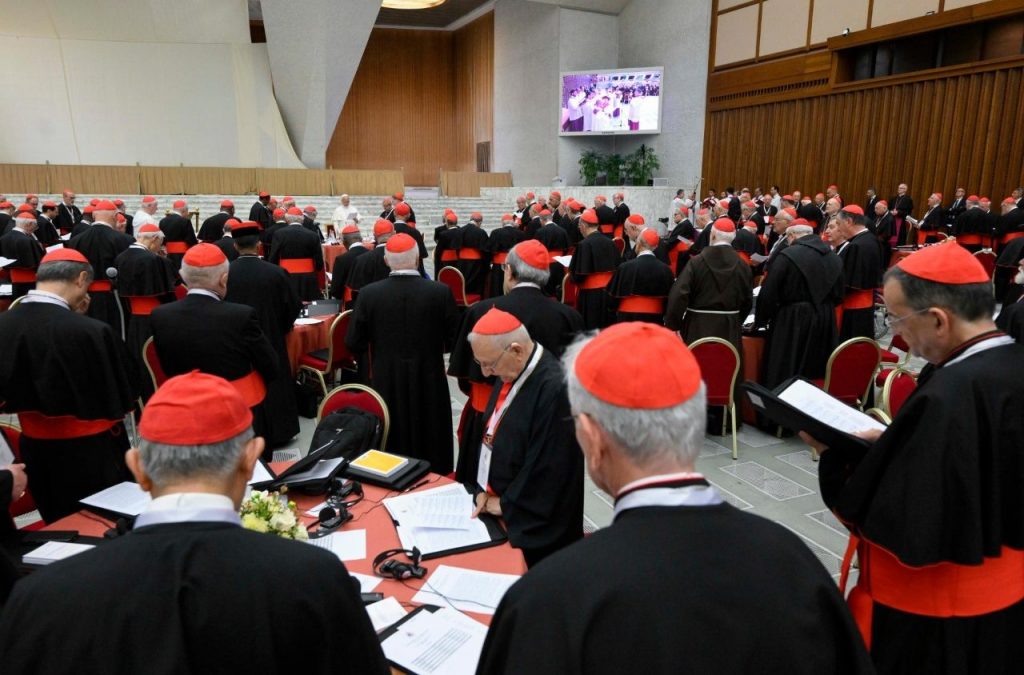
After a moment of prayer and silence, Cardinal Rugambwa initiated the group work and scheduled the resumption of the plenary session, after the recess, at 11:30 a.m., for the presentation of the groups’ reports. The Pope, who was present at the beginning of the session, returned before the group presented its reports.
Eleven groups presented reports before the Chamber: eight from the first group and three from the second.
Most groups focused their reflections on understanding the deep rifts of our time — between peoples and nations, within societies, and inside families — and on how these rifts create wounds, especially among the poor, the vulnerable, and the young (who lack the perspective of experience) and adults (who lack the wisdom that comes with age). Many presentations highlighted the dangers of a lack of meaning, significant relationships, and identity, all of which lead to a tribal mentality.
All of them emphasized the role of an exaggerated individualism that fosters the illusion that others exist solely for our own success.
In this context, the challenge of Artificial Intelligence emerges as an anthropological dimension that must be explor, by identifying shared human values. This involves everything from the call to acknowledge living beings as such — rather than reducing them to numbers and statistics — to experiencing and accepting the human sense of limitation (which AI tends to deny) and defending the dignity of work.
In this context, many groups spoke of the value of the common good –something difficult to grasp and internalize, and often overlooked by politics — and of how it requires a language of the heart to overcome conformity, corruption, and the sense of impossibility that arises from realizing that the assets and resources needed to achieve it are in the hands of a few.
Many groups affirmed that the sense of the common good stems from faith — faith in God and in the transcendent nature within every person –which impels humanity to surmount every barrier. The first of these barriers leads us beyond ourselves to experience solidarity with the poor as a response to individualism, to fully embrace Catholicism, to build generous relationships — rather than mere institutions — at all levels, and to seek a language capable of communicating with environments outside the Christian faith.
The role of politics is essential in this regard, as is the commitment of ecclesial institutions to the formation of future public servants, and to ensuring that the Church’s Social Doctrine is known and studied as a remedy for divisions. Many groups agreed that the antidote to individualism and division is the Gospel — a Church that fosters a sense of belonging and is capable of healing the wounds of our time; a renewed Church that avoids fundamentalism and polarization while revealing its «Good Samaritan» face — with Christians acting not merely as spectators of social ruin, but as wise architects rebuilding the city for everyone.
In this context, recognizing that we face the same challenges in many areas and across much of the world — and realizing how communion with Christ makes us less concerned with the opinions of others — is a sign of hope.
In this regard, various groups highlighted the value of synodality as a path of listening and dialogue, as well as of ecclesial responsibility.
Following the presentations, several Cardinals offered their comments, revisiting the session’s themes in more personal terms. Others expressed their gratitude to the Pope for his recent Apostolic Journeys and his commitment to peace.
The session concluded at 12:45 p.m. with the recitation of the Angelus, led by the Holy Father

Publicaciones relacionadas:
 Israeli Company Installs Water Generation Machine at Office of Papal Charities in Vatican City
 Cardinal Gerhard Mũller Rejects and Contests Accusations of Poor Financial Management and Denounces Defamatory Attacks
 “Be a sign of hope with words and gestures,” Pope asks Arab Catholic bishops
 Applauded by some, criticized by others: this is Cardinal Schönborn’s new successor at the helm of the prestigious episcopal see of Vienna
