

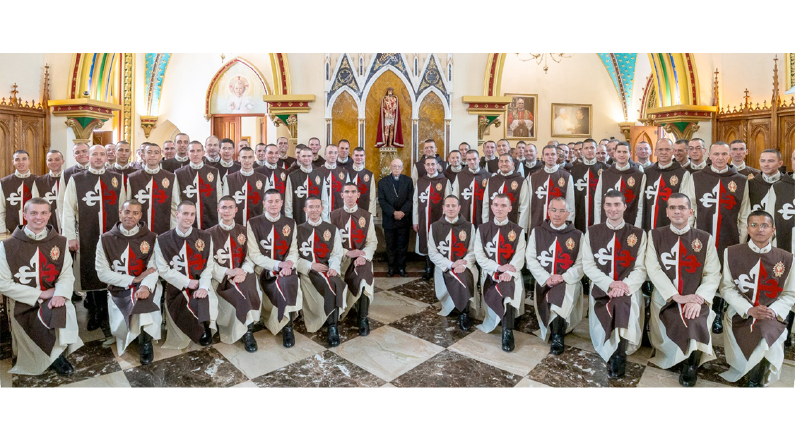
(ZENIT News / Roma, 04.08.2026).- In the Catholic Church, few gestures are as institutionally decisive as the laying on of hands. It is both sacramental and juridical, a visible sign that ecclesial life moves forward. For that reason, the announcement that the Heralds of the Gospel will ordain 31 deacons and 26 priests during the Easter Octave marks more than a liturgical milestone. It signals a shift—partial, but undeniable—in one of the most opaque Vatican interventions of recent years.
The ceremonies, scheduled for April 11 and 12 under the auspices of the clerical society Virgo Flos Carmeli, bring to an end a de facto suspension that had lasted since 2019. For nearly five years, dozens of vocations remained in limbo, caught in a canonical process that advanced without public charges, clear timelines, or a defined endpoint. In ecclesial terms, such a prolonged suspension is highly unusual, particularly when it affects the sacramental progression of candidates already formed for ministry.
The ordinations will be conferred by two senior prelates closely linked to the process itself. The diaconate ordinations will be administered by Fernando José Monteiro Guimarães, while the priestly ordinations will be presided over by Raymundo Damasceno Assis, who serves as pontifical commissioner for the Heralds. His role is particularly significant: as the Vatican-appointed authority overseeing the institution, his presidency underscores that the resumption is not a rupture with Rome, but a development occurring under its direct supervision.
The origins of the crisis date back to 2017, when the Holy See initiated an intervention into the Heralds, later reinforced in 2019 with the appointment of a commissioner. Oversight was entrusted to the Dicastery for Institutes of Consecrated Life and Societies of Apostolic Life, then led by João Braz de Aviz and more recently by Simona Brambilla. Yet throughout these years, the process unfolded with striking discretion. No formal accusations were publicly articulated, and the rationale for key decisions remained largely unexplained.
This absence of transparency has been one of the defining features of the case. Within ecclesiastical governance, apostolic visitations and commissarial interventions are not uncommon, particularly in periods of internal tension. However, they typically culminate in either reform, sanction, or closure. The Heralds’ situation instead evolved into a prolonged suspension, affecting not only governance structures but the personal trajectories of seminarians awaiting ordination.
The decision to proceed now with 57 ordinations suggests that, at least at the level of sacramental life, a degree of normalization is being permitted. It does not, however, resolve the underlying questions. Why were ordinations halted for so long without public clarification? What criteria have now been met to allow their resumption? And to what extent does this step indicate a broader rehabilitation of the institution?
Even the Heralds themselves frame the moment in explicitly spiritual rather. Their official communication situates the ordinations within the Easter Octave, invoking the theological logic of resurrection: a passage from trial to renewal. The citation from the Book of Nehemiah—“Do not be grieved, for this day is holy”—is not incidental. It reflects an effort to interpret years of uncertainty through a liturgical and providential lens, rather than a juridical one.
That framing resonates with a broader pattern in contemporary Catholic discourse, where complex governance issues are often articulated through spiritual language. For observers, however, the institutional dimension remains unavoidable. The intervention in the Heralds has been widely regarded as one of the most controversial of the previous pontificate, precisely because of its duration and opacity.
What is clear is that the resumption of ordinations alters the immediate landscape. Dozens of candidates, whose vocations had been effectively suspended, will now enter ordained ministry. In practical terms, this means new priests and deacons serving in parishes, apostolates, and missionary contexts—tangible outcomes that extend far beyond internal Church debates.
Yet the broader narrative remains unfinished. The case of the Heralds continues to raise fundamental questions about governance, accountability, and the balance between discretion and transparency within the Vatican system. The Church has, in effect, moved one piece on the board. Whether this signals the beginning of a resolution or merely a recalibration of an unresolved process is something that, for now, Rome has not fully explained.
Thank you for reading our content. If you would like to receive ZENIT’s daily e-mail news, you can subscribe for free through this link.

Publicaciones relacionadas:
 England and Wales Catholic Bishops release statement on gender, criticize gender ideology and sex-change operations
 Research Shows That Only 35% of American Catholics Have a Favourable Opinion About Biden
 British police arrest Catholic priest for publicly supporting the Palestinian cause
 The 7th shrine dedicated to Mary, mother of persecuted Christians, will open in Iraq
