

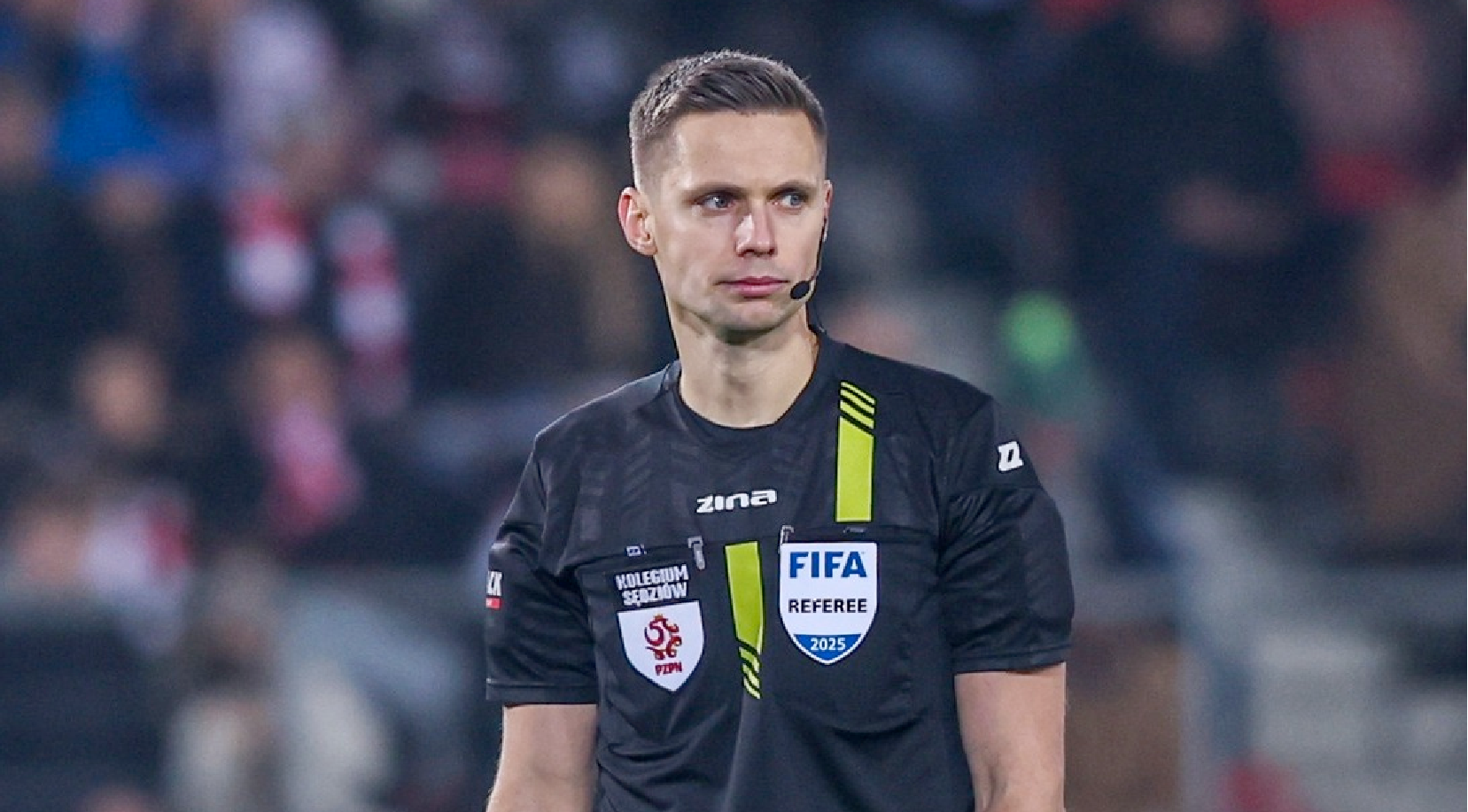
(ZENIT News / Rome, 05.14. 2026).- For years, Damian Sylwestrzak learned to live with an apparent contradiction: studying theology while forging his path in one of the most hostile and demanding environments in professional sports. But he insists that both vocations were never separate.
Sylwestrzak, 34, belongs to a generation of referees accustomed to constant scrutiny. Every decision is repeated in slow motion, debated on television, and judged on social media. In this ecosystem of constant tension, the Pole finds a point of equilibrium in his spirituality.
Before each match he prays silently. He also carries a small image of Jesus of Divine Mercy with the inscription «Jesus, I trust in You.» And after the opening whistle, he discreetly crosses himself, a custom he has maintained since the early years of his career. He is not seeking protection from the inevitable error. For him, this gesture is a way of giving thanks and remembering that his passion and his work have a deeper meaning.
His path to professional refereeing was not easy. While studying theology, he began direct regional matches in Poland. Many abandon this profession before reaching higher levels: insults, pressure, and loneliness are a daily part of the job. He himself has acknowledged that there were moments of burnout and doubt. However, he persevered until reaching the Ekstraklasa, the top Polish division, and later becoming a FIFA referee. His rise coincided with a period of increasing international exposure. He has directedd UEFA matches and national finals, including the Polish Super Cup.
In recent interviews, he mentions that at home he prays with his family before going to sleep and blesses the food with his children. These are discreet practices, far removed from the spectacle of sports, but which he considers essential for maintaining a coherent life. For him, this domestic example is more important than any public gesture.
This consistency is especially relevant in an environment where religion is often relegated to private or symbolic expressions. For example, FIFA has historically tightened its rules against explicit religious messages on the field of play, in violation of sporting neutrality. Even so, Sylwestrzak has found a way to live his faith without turning it into provocation or propaganda.
He has also admitted that some refereeing decisions cause him internal conflict, such as sending off a player who committed a foul without malicious intent, but he knows that sporting justice demands clarity and firmness, even when it is emotionally difficult to accept them.
This idea connects deeply with his theological approach. In refereeing, as in the spiritual life, judgment does not consist solely of mechanically applying rules, but of acting with conscience and integrity under pressure. The referee is obliged to make a decision in seconds while thousands of people are demanding something different. The temptation of fear or complacency appears constantly.
Sylwestrzak sees football as a school of character. He believes the sport teaches discipline, humility, and the ability to accept defeat. And he considers these values to have a profoundly human and spiritual component. «God is hope, comfort, and guidance,» he affirmed, describing his lifelong relationship with religion.

Publicaciones relacionadas:
 Donate 5 million euros to emblematic Parisian church: and here are the reasons why
 This Is the Young Spokeswoman for the U.S. Government: A Young Catholic Mother
 Monaco reaffirms its Catholic identity by halting abortion reform: Prince refuses to enact the law
 Carmelite friar who prays the Rosary online at 4 a.m. becomes Brazil’s most-watched streamer in 2025
