

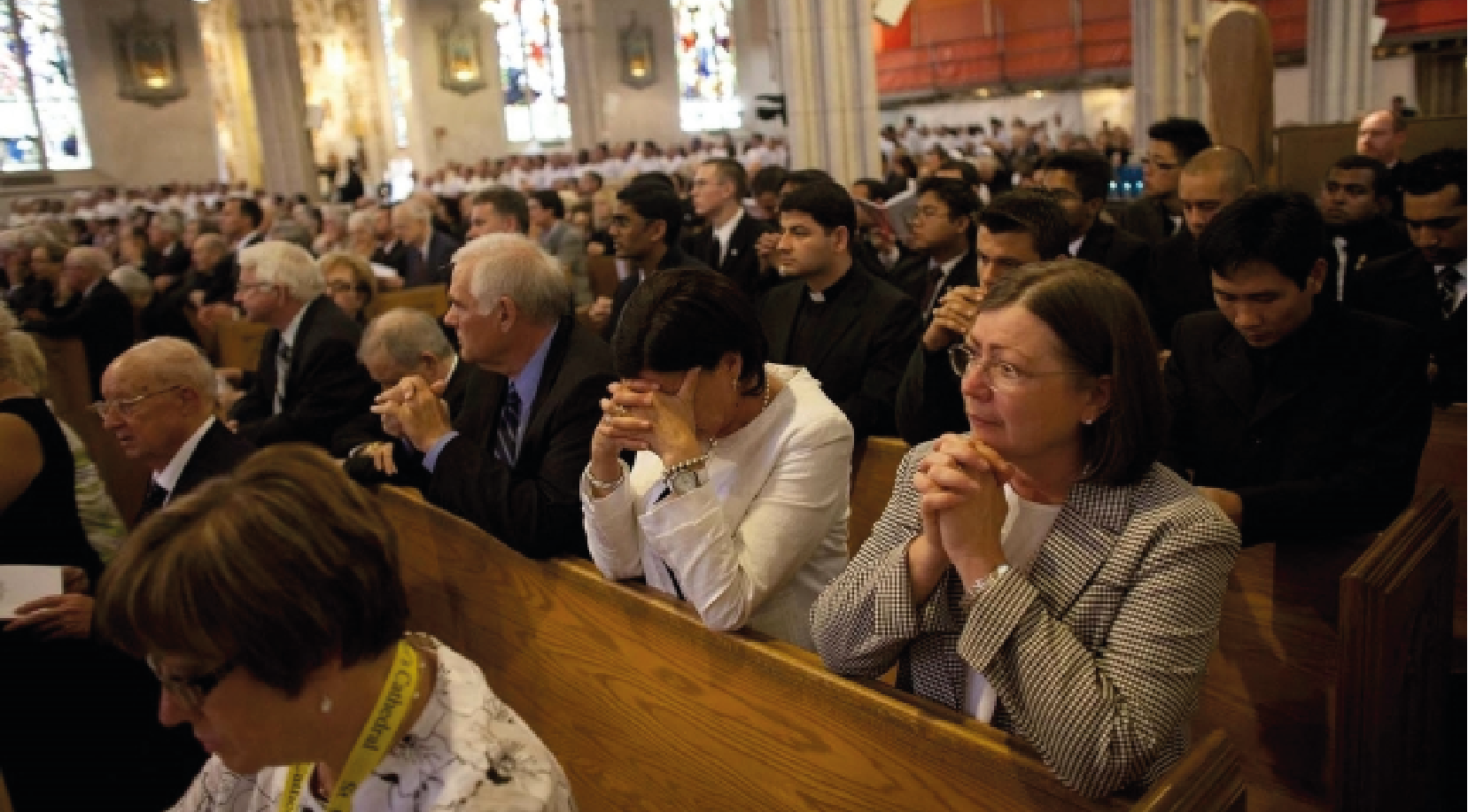
(ZENIT News / Rome, 04.28.2026).- For a quarter of a century, the trajectory of religious life in the United States has appeared unmistakably downward. Congregations shrank, public confidence in organized religion eroded, and the rise of those with no religious affiliation reshaped the cultural landscape. Yet new research suggests that the narrative, while not reversed, may be entering a more complex phase—one marked less by collapse than by adaptation and tentative recovery.
A major study released on April 24 by the Hartford Institute for Religion Research offers what its authors describe as “cautious optimism.” Based on a survey of 7,453 congregational leaders conducted between September and December 2025, the report identifies the first measurable increase in average attendance in 25 years.
The numbers remain modest when placed in historical context. At the turn of the millennium, the average congregation drew 137 people to in-person services. That figure fell dramatically over the following decades, reaching a low of 45 during the COVID-19 pandemic. Today, it stands at 70 adults—an improvement over the 65 recorded in 2020, but still far from earlier levels. Even so, for researchers who had long expected uninterrupted decline, the shift is significant.
The recovery is uneven. While 43 percent of congregations report growth of at least 5 percent, nearly as many—46 percent—continue to shrink by a similar margin. The remainder describe their situation as stable. What stands out, however, is that stabilization and growth now slightly outweigh decline, a reversal not seen in decades.
Patterns also vary by tradition. Catholic and Orthodox communities report the highest average attendance, around 200 participants, partly reflecting their structural organization with fewer but larger parishes. Evangelical congregations average 75 attendees, while mainline Protestant churches report around 50. Larger congregations tend to expand, while smaller ones remain more vulnerable to contraction.
Behind these figures lies a broader story of institutional resilience forged during crisis. When the pandemic forced the suspension of public worship, many religious communities rapidly adopted digital tools, livestreaming services and rethinking pastoral outreach. What initially appeared as an emergency response has since evolved into a more permanent transformation. Online giving, for example, has become a central feature of congregational life. The proportion of churches offering digital donations rose from 58 percent in 2020 to 76 percent in 2025, with approximately 40 percent of total income now coming through these channels.
Financial indicators reflect this shift. Median annual income increased from 120,000 dollars in 2020 to 205,000 dollars in 2025. Yet this growth is accompanied by rising costs, particularly in insurance and property maintenance, placing continued pressure on many communities. Evangelical and non-Christian groups are more likely to report budget surpluses, while traditional Protestant congregations more frequently face deficits.
The human dimension of this transition is equally revealing. The study notes an increase in volunteer participation and a decline in the number of clergy considering leaving ministry—an indicator that morale, long strained, may be stabilizing. For many pastors, the pandemic functioned as a moment of reckoning, forcing communities to confront structural weaknesses and reconsider their mission.
Researchers involved in the study emphasize that these developments should not be mistaken for a broad religious revival. Long-term trends of secularization remain in place, and the recent gains do not compensate for decades of losses. Rather than a return to a past “golden age,” what is emerging is a reconfigured religious ecosystem—leaner, more intentional, and in some cases more innovative.
This distinction is crucial. The data suggest that the congregations now showing signs of vitality are not those that simply endured the crisis, but those that adapted to it. Experimentation with new forms of engagement, clearer articulation of identity, and renewed emphasis on community life appear to be key factors in their resilience.
In a society often described as increasingly fragmented and marked by loneliness, the modest resurgence of participation in religious communities may also point to a deeper social need. Even as institutional trust remains fragile, the search for belonging has not disappeared. For some, local congregations—whether Catholic, Protestant, or Orthodox—continue to offer a space where personal meaning intersects with shared life.
The coming years will determine whether this fragile recovery can be sustained. The Hartford Institute plans further large-scale research by 2030, which may clarify whether the current uptick represents a temporary adjustment or the beginning of a longer-term stabilization.
For now, the evidence suggests neither collapse nor renaissance, but something more nuanced: a period in which American churches, after years of contraction, are learning to live differently within a changed cultural environment—less dominant, perhaps, but still present, and in some cases newly aware of their purpose.
Thank you for reading our content. If you would like to receive ZENIT’s daily e-mail news, you can subscribe for free through this link.

Publicaciones relacionadas:
 Shanghai: Why Did the Chinese Communist Party Violate Its Agreement with the Vatican?
 How Catholicism declined in Latin America over 10 years: study shows growth in agnosticism and other interesting data
 America’s Moral Barometer in 2025: Why Nurses Still Lead—and What the Decline of Clergy Trust Reveals
 ANALYSIS: An “ecclesial” experiment comes to an end: the German Synodal Path. The problem remains in the hands of the Pope
