

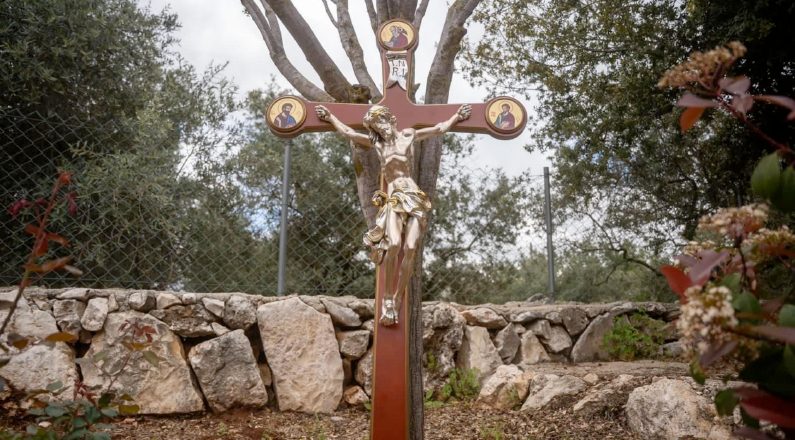
(ZENIT News / Tel Aviv, 04.21.2026).- The destruction of a crucifix in a small Lebanese village has reverberated far beyond its physical setting. What began as an act committed by a single soldier has evolved into a test case for accountability, religious sensitivity, and the fragile coexistence of faith and force in a conflict zone.
The incident took place in Debel, a predominantly Christian village in southern Lebanon, where a soldier from the Israel Defense Forces used a hammer to damage a statue of Christ. The act, captured and later circulated, quickly ignited indignation among local Christians and drew international attention. In areas like southern Lebanon, where Christian communities have endured decades of instability and emigration, such gestures are not perceived as isolated misconduct but as wounds to a vulnerable identity.
The military response was swift and unusually explicit. Following an internal investigation, the army israeli concluded that the conduct of those involved “completely deviated” from its ethical standards. The soldier who carried out the act, along with another who documented it, was removed from combat duty and sentenced to 30 days in military prison. The inquiry also revealed a broader failure: six additional soldiers were present but neither intervened nor reported the incident. Their inaction has prompted further disciplinary review at the command level.
Senior military leadership did not attempt to minimize the gravity of the episode. The chief of staff, Eyal Zamir, described the act as a moral failure that exceeded any acceptable norm and contradicted the values expected of the armed forces. Such language, while severe, reflects an awareness that actions against religious symbols risk inflaming tensions far beyond the battlefield.
Beyond disciplinary measures, the army undertook a symbolic gesture aimed at repairing the damage. In coordination with the residents of Debel, a new statue of Christ was installed to replace the one that had been destroyed. Military officials emphasized that the replacement had been organized from the moment the incident was reported, suggesting a recognition that restoration, however limited, was necessary to rebuild trust.
Yet the deeper significance of the episode lies not only in the response but in the context in which it occurred. The events unfolded shortly after the announcement of a ten-day ceasefire between Israel and Hezbollah, the Iran-backed armed group operating in Lebanon. Despite the truce, tensions remain high, with ongoing military operations and sporadic clashes continuing to claim casualties. In such magnitude, even isolated acts can acquire disproportionate meaning.
The Israel Defense Forces have reiterated that their operations in Lebanon are directed against Hezbollah and not against the civilian population. However, the circulation of images showing damage to civilian property—including religious sites—has complicated that narrative. In asymmetric conflicts, perception often carries as much weight as intention, and the line between military action and cultural or religious offense can become dangerously blurred.
For Christian communities in the Middle East, the episode touches on a broader and more sensitive reality. Though Lebanon remains one of the few countries in the region where Christians retain a visible public presence, their demographic and political position has been steadily eroding. Incidents that appear to target Christian symbols, even unintentionally, resonate with longstanding fears about marginalization and insecurity.
The case also highlights a recurring ethical challenge in modern military operations: how to ensure that soldiers, often operating under extreme pressure, remain attentive to the cultural and religious environments in which they act. The reinforcement of procedures regarding conduct toward religious institutions, announced after the investigation, suggests an attempt to address this issue at a structural level.
Still, the question remains whether such measures can fully prevent similar incidents. Military codes of conduct, however detailed, depend ultimately on personal discipline and moral formation. When these falter, the consequences can extend far beyond the individuals involved.
Thank you for reading our content. If you would like to receive ZENIT’s daily e-mail news, you can subscribe for free through this link.

Publicaciones relacionadas:
 Nicaraguan Bishop Rolando Álvarez Nominated for the Sakharov Prize for Human Rights
 U.S. Bishops Lose First Round in Legal Battle Against Trump’s Refugee Aid Freeze
 Archdiocese of Chicago brings alleged fraudsters who allegedly posed as abuse victims to trial
 Trump exonerates major Catholic university from million-dollar fine imposed by Biden
