

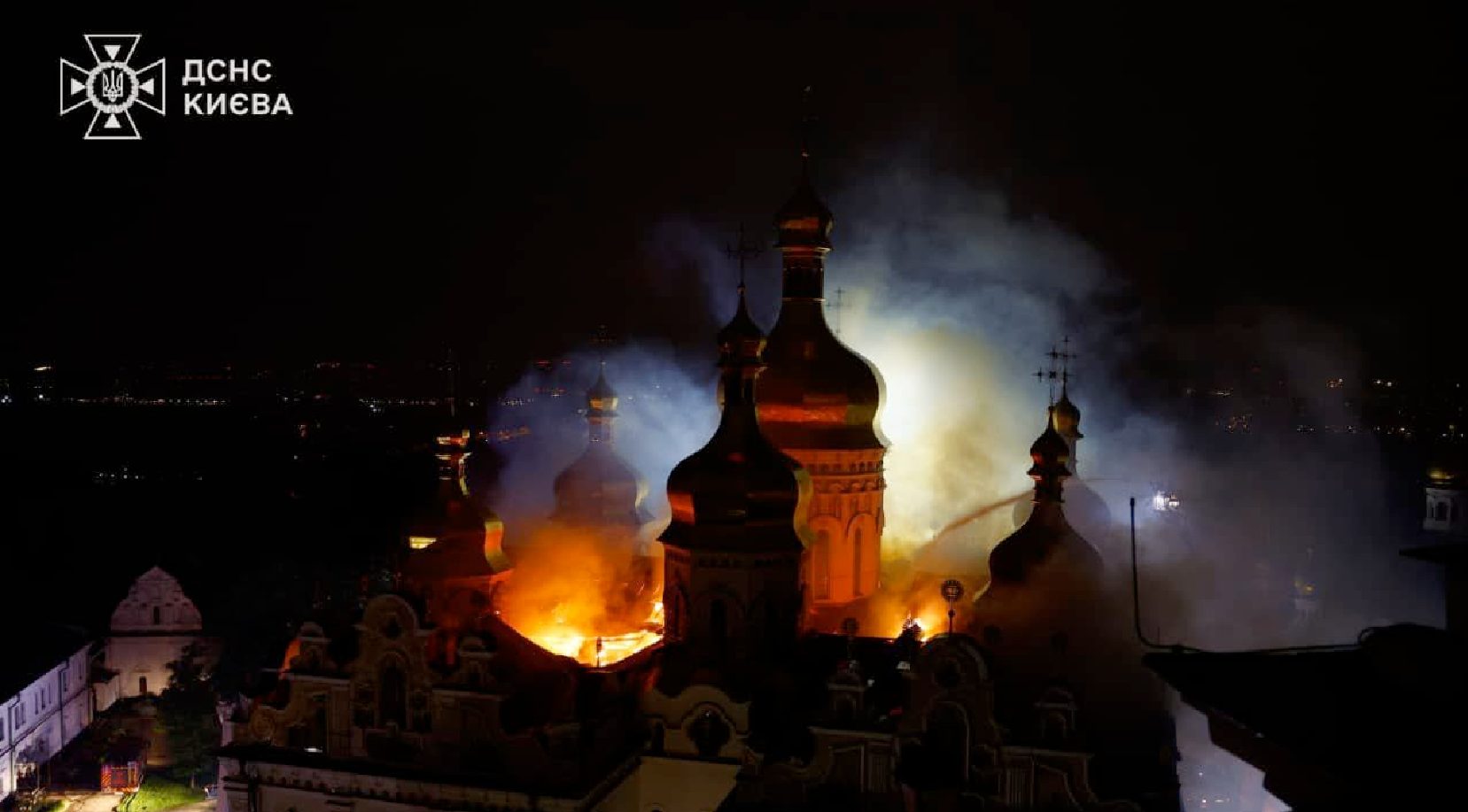
(ZENIT News / Kyiv, 06.15.2026).- The war in Ukraine has once again crossed a painful threshold, extending beyond military targets and civilian neighborhoods to strike one of the most revered symbols of Eastern Christian civilization. During a massive overnight assault on June 15, Russian missiles and drones hit multiple Ukrainian cities, leaving at least 11 people dead and dozens injured. Among the most alarming consequences was severe damage to the Cathedral of the Dormition in Kyiv, the spiritual centerpiece of the ancient Kyiv-Pechersk Lavra, a UNESCO World Heritage site and one of the oldest monastic centers in the Christian world.
As air raid sirens echoed across the Ukrainian capital, residents rushed to shelters while explosions illuminated the night sky. Fires broke out in several districts of Kyiv, damaging residential buildings, markets, and critical infrastructure. Yet it was the blaze that engulfed part of the Cathedral of the Dormition that drew international attention, transforming a military escalation into a global cultural and religious concern.
The cathedral occupies a unique place in the history of Christianity. Located within the Monastery of the Caves, founded in 1051, it stands at the birthplace of the spiritual tradition that shaped much of Eastern Slavic Christianity. The term “lavra” designates a major Orthodox monastic center, and the Kyiv-Pechersk Lavra became renowned for its network of underground caves inhabited by ascetic monks. For centuries, pilgrims from across Eastern Europe have traveled to the site, whose golden domes dominate the banks of the Dnipro River.
The Dormition Cathedral of the Kyiv Pechersk Lavra will be restored.
Thanks to the professionalism and swift actions of our emergency responders, the fires have been extinguished.
Russia attempted to destroy the Lavra for a second time – just as it did in 1941. Thankfully, we… pic.twitter.com/l5RQ8YQlXI
— Yulia Svyrydenko (@Svyrydenko_Y) June 15, 2026
According to Ukrainian authorities, the cathedral’s roof was struck during the attack, causing a major fire that damaged both exterior and interior sections of the building. President Volodymyr Zelensky described the incident as one of the gravest attacks on Christian culture since Russia’s full-scale invasion began in 2022. Metropolitan Epiphaniy, head of the Orthodox Church of Ukraine, called it “a crime against humanity, against history, and against Christianity,” urging believers worldwide to pray for the preservation of the shrine.
Moscow rejected responsibility for the damage, claiming that the cathedral had been hit by a Ukrainian Patriot air-defense missile rather than by Russian weapons. Ukrainian officials, however, insisted that Russian drones were responsible. As in many incidents throughout the conflict, competing narratives emerged immediately, while independent verification remained difficult amid the ongoing hostilities.
What is beyond dispute is the symbolic significance of the site. The Dormition Cathedral has already endured centuries of destruction and rebirth. It survived invasions, fires, and political upheavals before being almost completely destroyed during the Second World War. Following Ukraine’s independence, it was painstakingly reconstructed and reconsecrated in 2000, becoming a powerful symbol of national and spiritual renewal. Since 1990, together with Saint Sophia Cathedral, it has formed part of a UNESCO World Heritage designation. In 2023, the complex was added to UNESCO’s List of World Heritage in Danger.
The latest attack has reignited concerns about the vulnerability of cultural and religious heritage in modern warfare. UNESCO condemned the damage, while European leaders reacted with unusual intensity. French Foreign Minister Jean-Noël Barrot remarked that, for France, such an attack would be equivalent to bombing Notre-Dame Cathedral in Paris. French President Emmanuel Macron denounced any assault on what he described as humanity’s shared heritage.
The strikes formed part of one of the largest Russian aerial offensives in recent weeks. Ukraine reported that Russia launched 70 missiles and 611 drones overnight, primarily targeting Kyiv but also striking Kharkiv and Dnipro. Ukrainian air defenses intercepted 50 missiles and 582 drones, yet dozens of projectiles still reached their targets. Particularly troubling for Ukrainian commanders was the continued effectiveness of Russian ballistic missiles, which remain more difficult to intercept.
The human toll extended far beyond the monastery walls. In Kyiv, at least five people were killed and dozens injured, including children. In Kharkiv, emergency responders were among the dead after coming under attack. Meanwhile, Russian authorities reported casualties from Ukrainian drone strikes in the Tula region south of Moscow, underscoring how both sides increasingly bring the conflict deep into each other’s territory.
Last night, Russia launched another massive missile and drone attack against Ukraine. Kyiv was the primary target.
Four people were killed. My condolences to their families and loved ones.
Another 25 people were injured, including two children.
Damage and destruction were… pic.twitter.com/M9gQ5cYjcj
— Yulia Svyrydenko (@Svyrydenko_Y) June 15, 2026
The attack also unfolded against an important diplomatic backdrop. It came shortly after separate telephone conversations between U.S. President Donald Trump and both Zelensky and Russian President Vladimir Putin. At the same time, leaders gathered for the G7 summit in France, where Ukraine’s future, military assistance, and possible pathways toward a ceasefire dominated discussions. Zelensky renewed his appeal for stronger air-defense systems and tougher international pressure on Moscow.
Religious leaders from different Orthodox jurisdictions in Ukraine, including representatives historically linked to the Moscow Patriarchate, joined in condemning the destruction. Their rare convergence reflected the broader perception that the damage transcends ecclesiastical disputes. The attack touched a monument that belongs not only to Ukraine but also to the spiritual memory of Eastern Christianity itself.
For many Ukrainians, the flames that rose above the golden domes of the Lavra represented more than another wartime tragedy. They symbolized an assault on identity, memory, and faith.
Thank you for reading our content. If you would like to receive ZENIT’s daily e-mail news, you can subscribe for free through this link.

Publicaciones relacionadas:
 USA: bishops vote on the immediate future of the church in the country (these are the issues and results)
 Germany: Pectoral Cross That Benedict XVI Gave to a Parish in Traunstein Is Stolen
 Catholics bring their bishop to justice… for blasphemy. Italian justice admits case
 For the first time, a Pope will address the Spanish Parliament: it will be Leo XIV during his visit to Madrid in June 2026
