

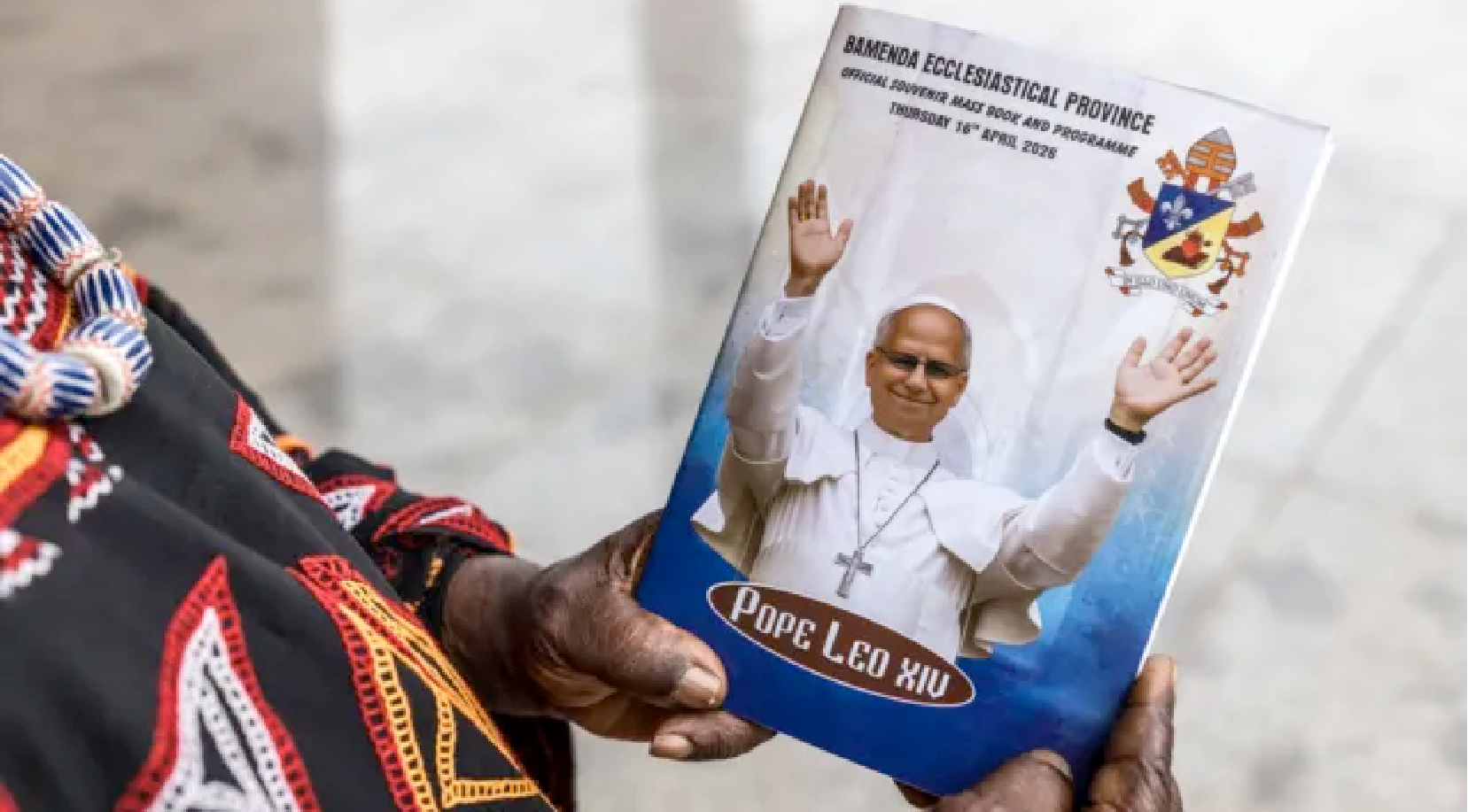
(ZENIT News / Yaunde, 04.15.2026).- The journey of Pope Leo XIV across Africa has unfolded at the intersection of faith, diplomacy and conflict, revealing not only the symbolic weight of a papal visit but also the volatile realities of regions often overlooked by the international community. What began in Algeria under tight security has quickly evolved into a test of whether spiritual authority can carve out even temporary spaces of peace in active war zones.
In Algeria, the Pope’s arrival was overshadowed by a suicide attack in the city of Blida on April 13. Two assailants detonated explosive belts near a police station, injuring several people after failing to reach their intended target. The attack, which occurred just hours after the pontiff landed, was not immediately claimed, though it reflects a persistent undercurrent of jihadist activity linked to groups such as Al-Qaeda in the Islamic Maghreb and the regional branch of the so-called Islamic State. Authorities imposed a strict information blackout, even limiting details available to the papal entourage.
Against this backdrop, Leo XIV maintained a message that deliberately transcended immediate violence. During a visit to the Monument to the Martyrs of Independence, he warned against turning migration routes into “cemeteries where even hope dies,” invoking both the Mediterranean and the Sahara as spaces of human and spiritual significance rather than corridors of despair.
Yet it is in Cameroon that the deeper stakes of the trip become evident. There, an armed separatist movement in the English-speaking regions has announced a rare three-day suspension of hostilities, timed to coincide with the Pope’s presence between April 15 and 17. The truce, coordinated by the Unity Alliance and endorsed by leaders of the self-proclaimed Ambazonian movement, is intended to allow civilians, pilgrims and clergy to move freely during the visit.
This gesture, framed by separatist leaders as a recognition of the Pope’s “spiritual significance,” underscores the unique moral leverage still attributed to the papacy in conflict zones. At the same time, it reveals the limits of that influence: the ceasefire is explicitly temporary, and leaders have warned against interpreting the visit as political endorsement of the central government in Yaoundé.
The city of Bamenda, where Leo XIV is scheduled to preside over a peace gathering, encapsulates the complexity of the crisis. Often described as the epicenter of the Anglophone conflict, Bamenda has endured years of violence since tensions escalated in 2016. What began as protests by lawyers and teachers defending the English-speaking legal and educational systems—rooted in the British colonial legacy—was met with repression, eventually spiraling into armed confrontation.
The human cost has been severe. More than 6,000 people have been killed, hundreds of thousands displaced, and at least 80,000 have fled to neighboring Nigeria. Education has been one of the most visible casualties: over 600,000 students have seen their schooling disrupted. Entire villages have been destroyed, while kidnappings—sometimes targeting clergy—have become a source of funding for armed groups, generating millions of dollars in ransom payments in recent years.
The roots of the conflict stretch back to the post-colonial settlement. After World War I, the former German colony was divided between France and Britain. When independence came in 1960, and a UN-supervised plebiscite followed in 1961, English-speaking regions were integrated into a predominantly French-speaking state, initially under a federal arrangement that later gave way to a centralized system. For many Anglophones, this shift eroded linguistic, legal and cultural autonomy, a grievance repeatedly articulated by Catholic bishops and civil society leaders.
In this context, the Catholic Church has occupied an uneasy but pivotal position. It has acted as both moral voice and informal mediator, advocating dialogue while navigating suspicion from both government authorities and separatist factions. Previous Vatican initiatives, including a diplomatic mission led by Pietro Parolin, failed to produce lasting results. Clergy have themselves become targets, underscoring the risks inherent in the Church’s engagement.
The decision of Leo XIV to travel personally to Bamenda—despite warnings from some observers that the visit could be misinterpreted politically—signals a deliberate pastoral strategy: to bear witness in situ, even at the cost of ambiguity. The reopening of Bamenda’s airport after six years of closure, and the rapid refurbishment of parts of the city, illustrate both the logistical impact of the visit and the desire of local authorities to project stability.
At the same time, broader insecurity continues to shape the country. In northern regions bordering Nigeria and Chad, jihadist groups such as Boko Haram and the Islamic State West Africa Province carry out attacks on villages, churches and schools, adding another layer to Cameroon’s complex crisis landscape. Christians, who make up roughly 60 percent of the population, have often been among the victims.
The Pope’s African itinerary reflects the growing demographic and strategic importance of the continent for global Catholicism. With approximately 288 million Catholics, more than one in five worldwide now lives in Africa. This shift has increasingly drawn papal attention to regions where the Church is expanding but also confronting acute social and political challenges.
Whether the temporary ceasefire in Cameroon will translate into longer-term de-escalation remains uncertain. Past attempts at dialogue, including a national consultation in 2019, have failed to halt the violence. Yet even a brief suspension of hostilities, in a conflict marked by mutual distrust and entrenched positions, carries symbolic weight.
Thank you for reading our content. If you would like to receive ZENIT’s daily e-mail news, you can subscribe for free through this link.

Publicaciones relacionadas:
 First Italian poll shows Pope Leo XIV surpasses Francis and Benedict in popularity
 Pope Leo XVI to visit Spain: here’s everything we know so far
 Leo XIV, a pro-life Pope, sends a message to participants in the March for Life in the USA
 Monaco will be the second destination for a trip by Pope Leo XIV at the end of March 2026: here is what is known
