

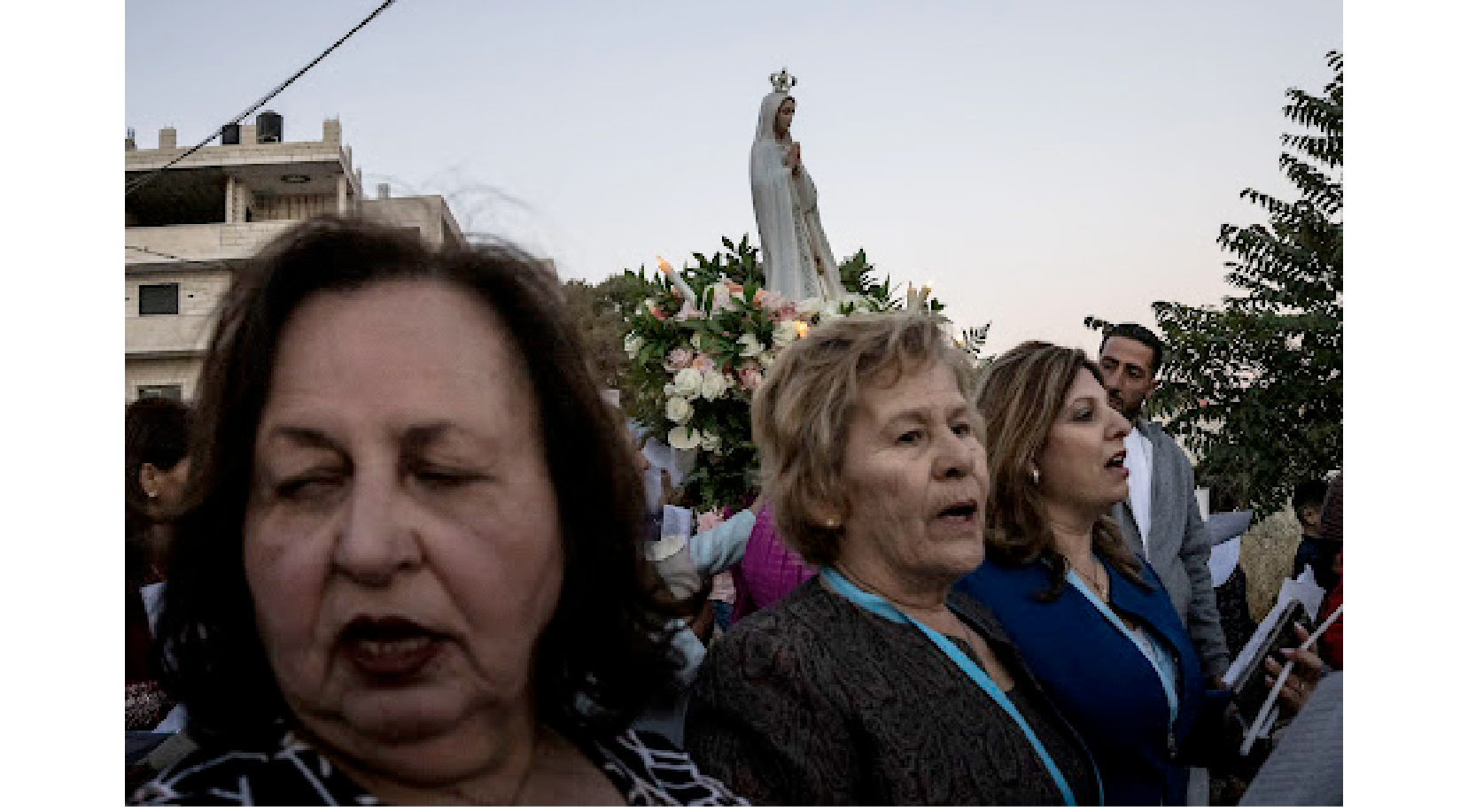
(ZENIT News / Jerusalem, 06.01.2026).- As violence continues to reshape the Middle East, Christian communities in the Holy Land and Lebanon find themselves living at the intersection of armed conflict, humanitarian disaster, and growing concerns over religious freedom. Recent events—from the disruption of a Catholic Marian celebration in the West Bank to worsening conditions in Gaza and renewed military escalation in Lebanon—have deepened fears among local churches that the region’s fragile social fabric is under unprecedented strain.
One of the most alarming incidents occurred in the Christian village of Taybeh, the last entirely Christian Palestinian town in the West Bank. On May 29, preparations for the community’s annual Marian festival were temporarily halted when Israeli military vehicles entered the village and ordered organizers to stop their work, despite the event having received the required authorizations from local authorities. Witnesses reported the use of a stun grenade, while surveillance drones and a military helicopter later appeared over the area.
The intervention sparked anxiety among residents and clergy, who feared the festival might be forcibly cancelled. Only after direct efforts by the Latin Patriarch of Jerusalem, Pierbattista Pizzaballa, were preparations allowed to resume and the celebration eventually proceed. Christian organizations monitoring the situation argued that the episode reflected the increasing vulnerability of Christian communities in the land where Christianity was born.
The Taybeh incident unfolded against a broader backdrop of tensions across the West Bank. Israel has recently advanced new administrative measures concerning land registration in Area C, a territory comprising roughly 35% of the West Bank. Critics fear that bureaucratic requirements attached to the process could make it difficult for many Palestinian families to prove ownership of lands traditionally governed through customary arrangements.
At the same time, controversy has erupted over the Israeli expropriation of the area surrounding the shrine traditionally associated with the Prophet Samuel, a site revered by Jews, Christians, and Muslims alike. The measure affects approximately 28 acres around the historic sanctuary north of Jerusalem. Israeli authorities describe the move as part of an archaeological preservation project, while Palestinian groups and Israeli activists from Peace Now argue that it forms part of a broader effort to consolidate control over religious and cultural heritage sites in occupied territory.
The dispute has renewed wider concerns about the future of Jerusalem’s holy places. Palestinian officials have warned that any attempt to alter the long-standing arrangements governing sacred sites—particularly the Al-Aqsa Mosque compound—could have serious consequences for regional stability. Jordan continues to exercise its internationally recognized custodial role over Muslim and Christian holy sites in Jerusalem, a responsibility dating back a century and reaffirmed in its 1994 peace treaty with Israel.
Meanwhile, the humanitarian situation in Gaza continues to deteriorate despite the ceasefire that entered into force in October 2025. Church agencies operating on the ground describe a catastrophe that extends far beyond military operations.
According to Caritas Jerusalem, the territory’s water infrastructure has been devastated, sewage systems have largely collapsed, and acute diarrheal illnesses have increased thirty-sixfold. Environmental destruction has reached staggering proportions: 97% of tree crops, 95% of shrubland, and 82% of annual agricultural cultivation have reportedly been lost. More than half a million people are now said to be living under famine conditions.
Particularly heartbreaking is the impact on children. Church sources report that more than 10,000 minors have suffered severe disabilities linked directly to the conflict. Caritas officials describe Gaza as having one of the highest concentrations of child amputees in modern history.
The parish priest of Gaza’s only Catholic parish, Father Gabriel Romanelli, has echoed repeated appeals from Pope Leo XIV for sustained humanitarian assistance. Although large-scale bombardments have diminished since the ceasefire, local sources report that more than 900 people have nevertheless died since the truce began. Food remains scarce, medicine is lacking, clean water is difficult to obtain, and much of the population faces a third consecutive summer living in tents.
Speaking before returning to the Vatican from Castel Gandolfo, on Tuesday, May 26, Pope Leo XIV urged authorities to ensure the delivery of humanitarian aid and to begin the work of reconstruction. He also renewed his call for dialogue, warning that violence only generates further hatred and insisting that the rights and dignity of every human person must be respected.
Beyond Gaza, the conflict has increasingly spilled into Lebanon. Israeli military operations have continued despite extensions of ceasefire arrangements, while Hezbollah has maintained attacks against Israeli targets. Lebanese health authorities report that since renewed tensions erupted, more than 3,300 people have been killed and over 10,000 wounded.
Israeli forces have also expanded their presence in strategic areas of southern Lebanon, including positions near the historic Beaufort Castle overlooking the Litani Valley. Lebanese leaders have accused Israel of imposing collective punishment, while Israeli officials insist their actions are necessary to counter Hezbollah.
Amid this turmoil, Christian leaders in Lebanon continue to offer a different witness. Archbishop Hanna Rahme has described how churches are increasingly providing shelter and assistance not only to Christians but also to displaced Muslim families fleeing the fighting.
According to the archbishop, many Christians initially struggled with the arrival of Shiite Muslim families seeking refuge, given Hezbollah’s role in the conflict. Yet acts of hospitality have transformed perceptions on both sides. Priests and religious communities have opened their homes, while displaced families have discovered a Church committed not to sectarian rivalry but to peace and coexistence.
His testimony highlights an often-overlooked reality of Middle Eastern Christianity. In a region frequently portrayed through the lens of geopolitical confrontation, local churches continue to function as bridges between communities. While political leaders debate borders, security arrangements, and strategic interests, many Christian institutions remain focused on a simpler mission: protecting human dignity regardless of religion, ethnicity, or political allegiance.
That witness may prove increasingly important. From Taybeh to Gaza, from Jerusalem to southern Lebanon, the challenges facing Christians today are inseparable from the wider crises affecting the entire region. Yet their experience also reveals something deeper: that religious freedom, humanitarian protection, and peaceful coexistence are not separate causes, but interconnected foundations for any lasting future in the land sacred to Jews, Christians, and Muslims alike.
Thank you for reading our content. If you would like to receive ZENIT’s daily e-mail news, you can subscribe for free through this link.

Publicaciones relacionadas:
 Between Drones, Settlers and Classrooms: How Violence and Administrative Israeli Pressure Are Reshaping Palestinian Life
 The last historic Christian village in the Holy Land, threatened with annexation by the Jewish state of Israel
 Israeli Jesuit David Neuhaus: the plan to remove Palestinians from Gaza feels like a kick in the stomach
 A besieged Easter: Lebanon’s Christians between bombardment, blocked aid, and a fragile hope
