

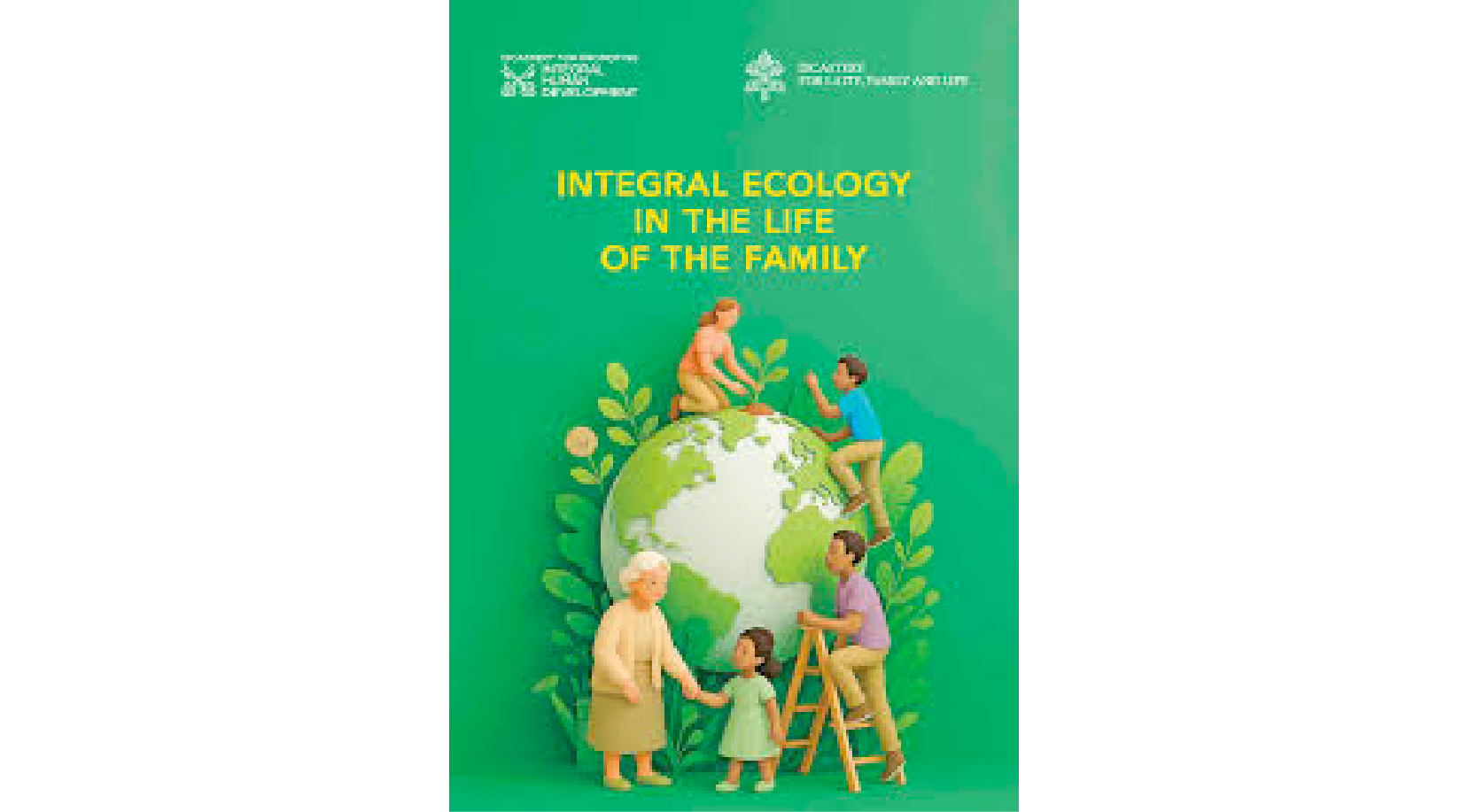
(ZENIT News / Rome, 05.08. 2026).- The Dicastery for Integral Human Development and the Dicastery for the Laity, Family and Life jointly published the document «Integral Ecology in Family Life» on April 27 of this yea, to promote care for Creation and human life within the family, which is surrounded by anti-life ideologies that encourage abortion and sterilization as means of controlling population growth.
The document was drafted by theologians, priests, and married couples, drawing on the speeches of Pope Francis and Pope Leo XIV, who called for listening to the cry of the poor and the Earth and offering concrete, applicable responses based on the principles of the Post-Synodal Apostolic Exhortation Amoris Laetitia and the teachings of the Encyclical Laudato Si’.
The document explains how «this situation results in an incalculable number of children never being born, children who have been denied the right to the primordial gift of Creation, the gift of life itself.» It also warns that this horizon advances «when society is disturbed by attempts to erase sexual difference because it no longer knows how to confront it.»
It shows that there is «a tendency to perceive population growth as the main threat to humanity,» which is why some governments «spread the advocacy, sometimes even promoting the adoption of sterilization practices in poor countries.» Thus, «a strong control of birth rates» is imposed.
The document draws on principles and references from the Constitution Gaudium et Spes of the Second Vatican Council, the Encyclical Caritas in Veritate of Pope Benedict XVI published in 2009, the Apostolic Exhortation Familiaris Consortio of 1981 by Saint John Paul II and Sollicitudo Rei Socialis of 1987, as well as Pope Francis’ Evangelii Gaudium of 2013.
Faced with the promotion of abortion and the lack of respect for life, the document invites us to focus our attention on other factors that it considers truly harmful, such as extreme consumerism, pollution, the throwaway culture, and the desire to exercise absolute power over the human body through its manipulation, facilitated by technological advances.
What root does the document identify for these trends? It sees it as meaning that «the right to life and natural death is not respected when conception, gestation and birth of man are made artificial, if human embryos are sacrificed for research.»
The Church’s doctrine offers the integral education of children at home to cultivate love and sexuality. And we must never forget that learning to accept one’s own body, to care for it, and to respect its meaning is essential for true human ecology. Thus, «acceptance of one’s own body as a gift from God is necessary to welcome and accept the whole world as a gift from the Father and our common home.»
The document proposes educating children through age-appropriate conversations «about the need to protect human life against abortion, surrogacy, and euthanasia; about the need to care for people with difficulties within the family; and about the beauty, dignity, and meaning of human sexuality.»
It also calls for involvement in local schools to promote ecological improvements in facilities and educational content through initiatives such as school gardens and the study of botany, which lead to the integral development of each individual.
Each chapter of the document has four sections: explanations, concrete implications, questions for reflection, and operational proposals. For example, it opens with questions such as, «Has our family experienced situations in which natural resources have been used (…) in a way that creates or promotes social tensions or inequality?» or «Have we tried in any way to measure our level of consumption as a family and in our home?»
It includes concrete recommendations such as teaching children to «respect and care for animals,» «avoid wasting food or electricity,» «use public transport more frequently,» explore «low-cost options for insulating the home against heat and cold,» and properly sort household waste.
It also raises questions about the educational role of parents and the tensions they face in transmitting values of moderation in a consumerist culture and a climate of dominant social pressure: «Parents who try to instill values such as moderation and a modest lifestyle may be perceived as authoritarian figures or as people who ignore marketing and peer pressure. How can such parents be supported in overcoming these difficulties?»

Publicaciones relacionadas:
 Vatican announces doctrinal document on monogamy: here’s what we know
 Against Western polyamory and African polygamy: this is what the Vatican’s new (and beautiful) document on marriage says
 Europe Union Yanks Funding from Pro-Life Groups
 Surprising study shows birth projections for 2026: only 8 out of every 100 babies will be born on three continents combined
