

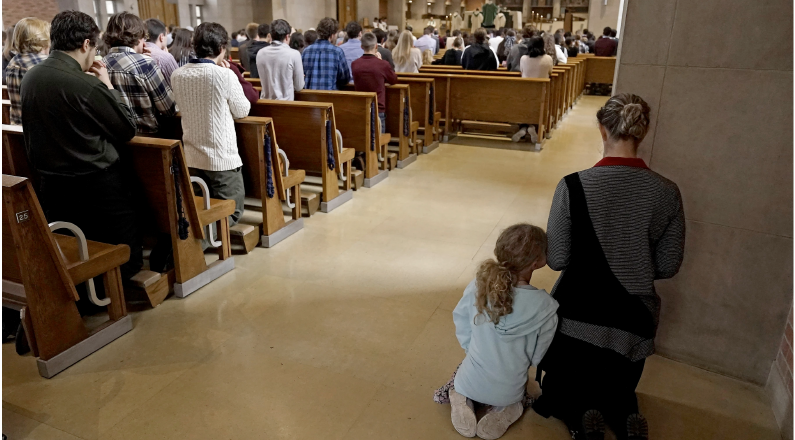
(ZENIT News / Rome, 06.21.2026).- A new study offers a striking reminder that the Catholic Church remains a powerful spiritual destination for many Americans. More importantly, the research suggests that the motivations driving today’s converts differ significantly from those that characterized previous generations.
A nationwide survey of adults participating in the Order of Christian Initiation of Adults (OCIA) during 2026 found that most newcomers are not entering the Church primarily because of family pressure, marriage, or social convenience. Instead, they are searching for something deeper: God, truth, meaning, and inner peace.
The study, conducted by the Archdiocese of Chicago in collaboration with 20 dioceses across the United States, gathered 2,127 responses between February and May. Its findings challenge some long-standing assumptions about conversion in contemporary America.
The strongest motivation by far was spiritual. Eighty-five percent of respondents said their desire to draw closer to God played a central role in their decision to become Catholic. Closely behind were the aspirations to grow in virtue and goodness (77%), to gain a deeper understanding of truth (76%), and to find greater interior peace (72%).
These results paint a picture of conversion that is less about social identity and more about a personal quest for transcendence. In a society often marked by anxiety, fragmentation, and ideological conflict, many respondents appear to be seeking stability in something enduring.
That search frequently leads them to the distinctive features of Catholic life. More than two-thirds of participants (68%) said they were attracted by the Church’s liturgy, prayer, sacramental life, and sacred rituals. Meanwhile, 65% pointed specifically to the wisdom of a 2,000-year-old institution as a valuable guide for navigating modern life.
This finding may surprise observers who assume younger generations are indifferent to tradition. In fact, many converts seem drawn precisely by the Church’s historical continuity. For them, Catholicism offers not novelty but rootedness.
Perhaps one of the most remarkable findings concerns the declining importance of marriage as a pathway into the Church. For decades, sociologists identified marriage to a Catholic spouse as one of the principal reasons people converted.
That pattern appears to be changing dramatically.
Only 26% of today’s catechumens and candidates for full communion reported that dating or marrying a Catholic played a significant role in their journey. By comparison, research based on earlier Pew studies found that 72% of Catholic converts in the past cited marriage as an important factor.
The shift suggests that contemporary converts are increasingly arriving through personal conviction rather than family circumstances.
The survey also uncovered interesting generational differences. Among Generation Z respondents whose conversion journey involved a Catholic romantic relationship, women represented nearly two-thirds of participants. Among Millennials, the distribution between men and women was roughly equal, while older generations showed a stronger male presence in this category.
Community remains important, though not necessarily decisive. Slightly more than half of respondents said they were inspired by Catholic friends, family members, or parish communities. Yet these social influences ranked below spiritual and intellectual motivations.
Equally revealing were the factors that played a comparatively minor role. Participants generally ranked the Church’s positions on social issues and its extensive charitable work lower than personal spiritual considerations. This does not imply indifference to those matters, but it suggests that most converts begin their journey by asking existential questions rather than political ones.
The path into the Church, however, is not without obstacles.
Many respondents described feeling intimidated by Catholic worship when they first encountered it. Some struggled to understand the structure and symbolism of the Mass. Others worried about fitting into established parish communities or feared they might never fully grasp every aspect of Catholic doctrine.
Researchers noted that uncertainty about Church teaching often created hesitation. Some prospective converts wondered whether they could honestly embrace the fullness of Catholic belief and feared making a commitment they might later find difficult to sustain.
Yet despite those concerns, thousands continue to take the step.
The study’s broader significance extends beyond statistics. At a moment when public discussion about religion frequently focuses on decline, scandal, or institutional challenges, these findings highlight another reality: many people are still discovering the Catholic faith not primarily through cultural inheritance, but through a deliberate search for meaning.
The attraction appears to be neither political nor merely sociological. For many of today’s converts, Catholicism represents an encounter with questions that modern life has not eliminated—the search for truth, the desire for virtue, the longing for peace, and, ultimately, the pursuit of God.
That may be the most important lesson emerging from this research. The Church continues to grow not only because it preserves a rich tradition, but because many people still believe that tradition points beyond itself to something eternal.
Thank you for reading our content. If you would like to receive ZENIT’s daily e-mail news, you can subscribe for free through this link.

Publicaciones relacionadas:
 Germany: research reveals that young clergy are conservative and opposed to ecclesiastical progressivism
 Germany: Study Shows That Young Muslims Believe More in God Than Catholics
 Study shows that young women are more likely than young men to have lost their religious faith
 Why hire a young person of faith? A global study reveals that young people of faith bring hope and civic engagement to the job market
