

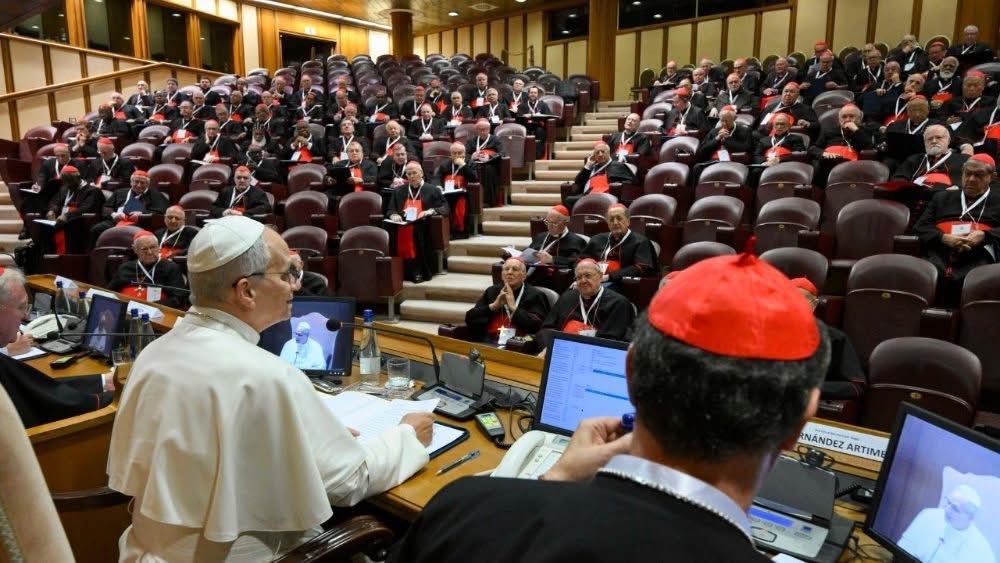
(ZENIT News / Rome, 06.22.2026).- As wars, political polarization, and social fragmentation continue to reshape the global landscape, Pope Leo XIV is preparing for an consistory that could offer important clues about the governing style of his pontificate and the future direction of the Catholic Church.
Scheduled for June 26 and 27, the meeting will bring cardinals from around the world to the Vatican for two days of prayer, reflection, and structured discussion. More than a simple consultation, the gathering reflects Leo XIV’s stated desire to strengthen collegiality within the Church by creating regular opportunities for the world’s senior churchmen to participate more directly in discernment and decision-making.
The format itself reveals much about the Pope’s approach. Participants will be divided into twenty working groups. Nine groups will consist primarily of diocesan cardinals, including papal nuncios and retired ordinaries, while eleven will bring together members of the Roman Curia and non-elector cardinals. Each group will be guided by a moderator and a secretary responsible for synthesizing the discussion into a final report.
Rather than lengthy speeches, the process emphasizes concise interventions and attentive listening. Cardinals will initially have three minutes to present their reflections, followed by a second round of two-minute contributions focused exclusively on engaging ideas already raised by others. The method is designed to encourage genuine dialogue rather than parallel monologues.
The first day will begin after a Eucharistic celebration presided over by the Pope in St. Peter’s Basilica. The opening session will explore a foundational question for the Church’s mission: «In what kind of world are we called to proclaim the Gospel?» The reflection will be introduced by Cardinal Grzegorz Ryś of Kraków through a biblical meditation.
Attention will then shift to one of the most pressing concerns of the present age: the rise of geopolitical tensions and social conflict. During an afternoon session entitled «The Culture of Power and the Civilization of Love,» Cardinal Víctor Manuel Fernández, Prefect of the Dicastery for the Doctrine of the Faith, will introduce discussion based on the fifth chapter of Leo XIV’s first encyclical, Magnifica Humanitas.
Cardinals will be invited to examine how contemporary conflicts affect both nations and local Churches, and to consider what attitudes, language, and pastoral initiatives might help foster reconciliation and peace. At a time when numerous regions are experiencing armed conflict, ideological polarization, and social distrust, the discussion is expected to address not only diplomatic concerns but also the Church’s role as a moral and spiritual agent of unity.
The second day will focus on what organizers have called the «worksites of our time»—the challenges that hinder the pursuit of the common good. Cardinal Stephen Brislin of Johannesburg will lead reflections on social fractures, exclusion, and the voices that the Church may not always hear sufficiently. The topic signals Leo XIV’s intention to connect evangelization with careful attention to contemporary social realities.
The final session will turn toward the implementation of the Synod process and preparations for the assemblies scheduled for 2027 and 2028. Cardinal Mario Grech will present the working framework before an open exchange with the Pope himself. In a format rarely seen at this level, cardinals will be able to address Leo XIV directly in closed session, with each intervention limited to three minutes.
The Vatican has requested strict confidentiality during the proceedings. Journalists will not be admitted to the meeting hall, and participants have been asked not to grant interviews during the discussions in order to preserve what officials describe as a climate of fraternal exchange. At the same time, transparency will not be entirely absent. The Pope’s principal address and the final conclusion of the consistory will be broadcast live, while summaries of the discussions and the introductory presentations will be released to the press.
The gathering represents the second extraordinary consistory of Leo XIV’s pontificate. It also marks a significant evolution from the last comparable meeting convened under Pope Francis in 2022, which focused primarily on Curial reform and the creation of new cardinals.
This year’s agenda is broader and more outward-looking. Rather than concentrating on ecclesiastical structures, Leo XIV is asking the Church’s leadership to confront a deeper question: how can the Gospel be proclaimed credibly in a world marked by division, conflict, and uncertainty? The answer may not emerge in a single meeting, but the Pope appears determined to ensure that the search for it is undertaken together.
Thank you for reading our content. If you would like to receive ZENIT’s daily e-mail news, you can subscribe for free through this link.

Publicaciones relacionadas:
 Pope Leo entrusts the important Dicastery that elects bishops to a Carmelite and canonist
 Pope Leo XIV: yes to synodality, but without undermining the authority of the bishop
 Pope Leo XIV continues to reshape the Roman Curia: Meet the new Australian prefect of the Dicastery for Legislative Texts
 Archbishop of Paris Announces More Details of the Pope’s Visit to the French Capital
