

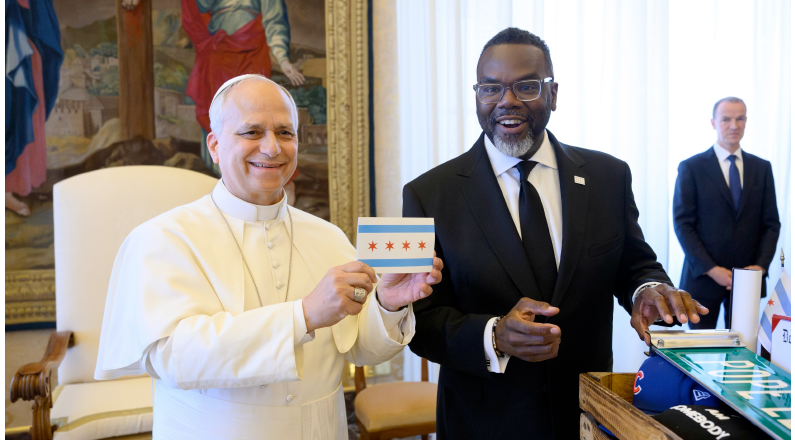
(ZENIT News / Rome, 06.01.2026).- The increasingly public disagreement between Pope Leo XIV and U.S. President Donald Trump has entered a new phase, with the American president once again criticizing the pontiff over Iran and nuclear weapons following a Vatican meeting involving Chicago Mayor Brandon Johnson.
The latest exchange illustrates how the Vatican’s moral diplomacy under Leo XIV is colliding with the harsher geopolitical language that often dominates contemporary international affairs. At the center of the dispute lies not only Iran’s nuclear ambitions but also a broader disagreement about war, peace, migration, and the role religious leaders should play in public debates.
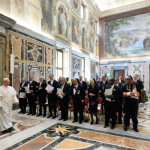
The controversy erupted after Johnson visited the Vatican on May 28 and met with the Pope. Photographs released afterward showed the Chicago-born pontiff and the mayor exchanging gifts.
A couple of days later, Trump reacted sharply on social media. Referring to Johnson, a politician he has repeatedly criticized over crime and immigration policies in Chicago, the president wrote that someone should explain to the Pope that the mayor was “useless” and that Iran “cannot have a nuclear weapon.”
The comment revived a dispute that has simmered for months. Trump has repeatedly accused Leo XIV of being insufficiently firm regarding Iran and has even claimed that the Pope would tolerate an Iranian nuclear capability. The Vatican has firmly rejected that characterization.
Leo XIV has publicly stated that the Catholic Church has long opposed all nuclear weapons, a position deeply rooted in modern Catholic social teaching. The Holy See’s position was reinforced by Pietro Parolin, who emphasized that the Vatican has consistently worked for nuclear disarmament and intends to continue doing so.
The disagreement is therefore not about whether nuclear weapons are desirable. On that point, the Vatican’s position is unequivocal. Rather, the dispute concerns the means by which international security should be pursued and the Pope’s criticism of military responses to geopolitical crises.
Since the outbreak of the conflict involving Iran earlier this year, Leo XIV has repeatedly appealed for negotiations, restraint, and a return to dialogue. He has openly questioned the effectiveness of military escalation and warned about the human consequences of modern warfare. Trump, by contrast, has defended a far more confrontational approach toward Tehran and has argued that preventing an Iranian nuclear capability requires maximum pressure.
The tensions extend beyond foreign policy. Trump has also criticized the Pope over immigration issues, while Leo XIV has consistently defended the dignity of migrants and refugees, echoing themes that have become central to Catholic teaching in recent decades. Meanwhile, the president has repeatedly targeted Chicago’s status as a sanctuary city and has accused Johnson of obstructing federal immigration enforcement efforts.
What makes this confrontation particularly noteworthy is that it involves the first American-born pope engaging with an American president during a period of intense political polarization. Historically, relations between Washington and the Holy See have often included disagreements, but they have generally remained behind closed diplomatic channels. Under Leo XIV, differences are becoming increasingly visible.
Yet the Pope has shown little sign of retreating from public engagement. He has stated that he is not afraid to speak openly about the Gospel’s demands, regardless of the political consequences. For the Vatican, questions of war, peace, migration, and nuclear disarmament are not merely political controversies; they are moral issues touching on the sanctity of human life and the common good.
Thank you for reading our content. If you would like to receive ZENIT’s daily e-mail news, you can subscribe for free through this link.

Publicaciones relacionadas:
 Trump and Vance prolong the conflict with Leon XIV as Russia and Brazil join the controversy
 On the Controversy with Trump, Leo XIV Denounces a «Not Entirely Accurate Narrative»
 The Pope’s Complete Agenda: Mass for the Inauguration of the Pontificate, Possession of Rome Cathedrals, and First General Audience
 3 key words of the missionary action of the Church and of the work of the Holy See’s diplomacy, according to Leo XIV
