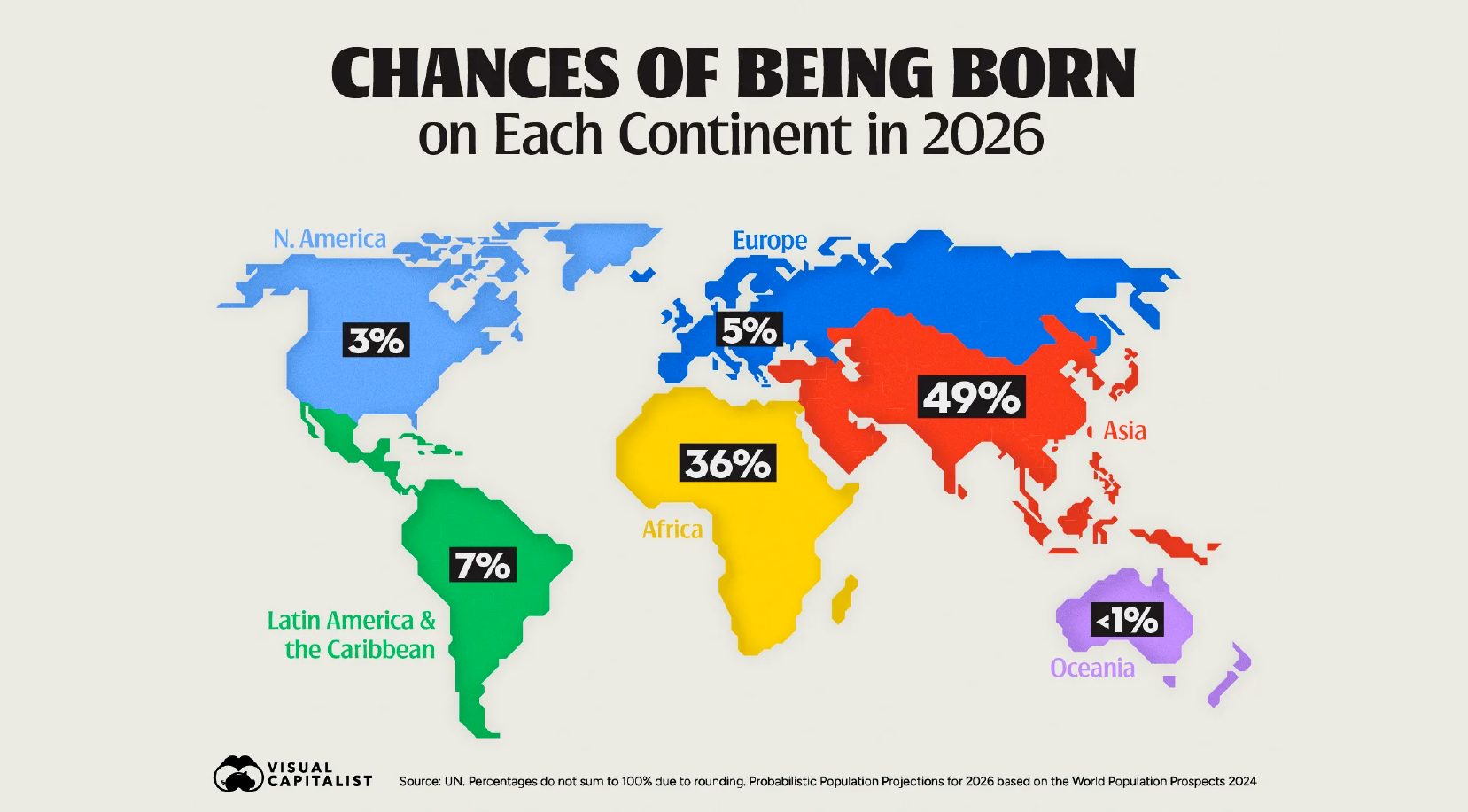
(ZENIT News / Washington, 03.04.2026).- According to recent projections highlighted by The Visual Capitalist and based on United Nations data, only 8 percent of the world’s births in 2026 will occur in Europe, North America and Oceania combined. In absolute numbers, that translates into roughly 4 million births in North America, 5 million in Europe and fewer than 1 percent of global births in Oceania.
The overwhelming majority of humanity’s newest members — 85 percent — will instead be born in Africa and Asia. Asia alone is expected to register approximately 64.9 million births in 2026, accounting for about 49 percent of all global births. Africa will follow with more than 47 million births, or 36 percent of the total. Latin America and the Caribbean will account for 7 percent.
Even with falling fertility rates in countries such as China, Japan and South Korea, Asia’s demographic weight remains formidable because of its vast population base. Africa, meanwhile, continues to experience high levels of population growth despite decades of international campaigns aimed at reducing fertility rates through widespread promotion of contraception and abortion.
These figures are not merely statistical curiosities. They signal a profound structural shift in the global balance of human capital, economic potential and cultural influence. In the 20th century, Europe and North America shaped world institutions, markets and norms in large part because they possessed demographic vitality alongside industrial strength. In 2026, that vitality is clearly elsewhere.
The Western fertility collapse
The demographic downturn in the West is neither sudden nor accidental. For decades, most European countries have posted fertility rates well below the replacement threshold of 2.1 children per woman. North America has followed a similar trajectory. The result is an aging population, shrinking labor forces and mounting fiscal pressure on pension and healthcare systems designed for expanding societies.
Public debate in some Western countries has increasingly revolved around the so-called “Great Replacement” theory — the idea that native populations are being supplanted by migrants. Yet from a strictly demographic standpoint, the more decisive factor is internal: persistently low birth rates among native populations themselves.
As British writer Louise Perry recently observed, modern societies depend on people who are not reproducing in sufficient numbers to sustain them. If a social model fails to generate the next generation, it ultimately undermines its own continuity. Political polarization, social fragmentation and economic strain may be early symptoms of this deeper demographic contraction.
This does not mean migration is irrelevant. In fact, demographic imbalances between regions naturally intensify migratory flows. When 36 percent of the world’s babies are born in Africa and just 5 percent in Europe, the long-term pressure for movement — legal or irregular — becomes structurally embedded in the global system. But migration alone does not explain why Western populations are aging and, in some cases, shrinking. Fertility decline preceded recent migration waves and has continued regardless of shifting border policies.
A cultural and moral dimension
Demographic change is never purely economic; it is also cultural. The transformation of family structures in the West since the mid-20th century — often associated with the Sexual Revolution — has reshaped marriage patterns, delayed childbearing and normalized smaller families. At the same time, abortion remains widespread in many Western countries. The result is a stark gap between conceptions and live births.
In the United Kingdom, for example, abortion rates underscore that many pregnancies do not result in children being born. Whatever one’s moral or political position, the arithmetic is inescapable: societies that conceive more children than they carry to term are choosing, at scale, to limit their demographic future.
Some analysts suggest that rising migration may itself depress native fertility, as social change and perceived cultural discontinuity make potential parents less inclined to have children. Whether causal or merely correlated, the feedback loop is difficult to ignore: low fertility increases reliance on immigration, which in turn can alter social dynamics in ways that further discourage childbearing.
A global pivot
Meanwhile, Africa’s demographic trajectory points in the opposite direction. With more than 47 million births projected in 2026 alone, the continent is poised to play a central role in the 21st century. Its population is young, its median age far below that of Europe, and its workforce potential enormous — provided education, governance and economic development keep pace.
Asia’s 64.9 million births reinforce its continued centrality in global affairs. Even as fertility declines in East Asia, South and Southeast Asia maintain substantial demographic momentum. This ensures that Asia will remain not only a manufacturing and technological powerhouse but also the primary reservoir of global population growth.
What does this mean for the West? At minimum, it suggests that economic dominance and cultural self-confidence can no longer rely on demographic weight. Societies that age rapidly must either redesign their social contracts or confront stagnation.
More profoundly, it raises a civilizational question. If a culture does not reproduce itself biologically, can it expect to endure institutionally? Modernity has achieved unprecedented material progress, yet its most advanced societies are those least inclined to bring forth new life.
The map of births in 2026 does not merely describe where babies are born. It signals where the future workforce, the future believers, the future voters and the future parents will come from. Demography does not determine everything, but it sets the parameters within which everything else unfolds.
In that sense, the cradle may be the most consequential geopolitical instrument of all.
Thank you for reading our content. If you would like to receive ZENIT’s daily e-mail news, you can subscribe for free through this link.